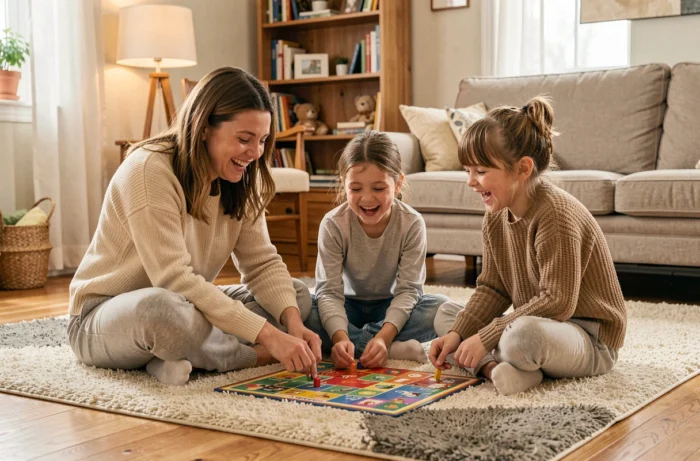
What type of family interaction produces a measurable effect on children’s well-being: a special outing on the weekend or a shared routine every evening? Research published in 2026 shifts the focus. The regularity of daily exchanges, shared meals, screen-free games, and evening readings weighs more than the raw quantity of time spent together. This article compares family fun activity formats based on their realistic frequency and documented impact.
Family Routines and Occasional Activities: What the Data Opposes
Two approaches coexist in most households. On one side, event-based activities (trip to an amusement park, escape room, special day). On the other, micro-rituals repeated daily (shared meals, shared reading, short board games). Recent publications allow for a structured comparison.
| Criterion | Occasional Activity (outing, special workshop) | Daily Ritual (meal, reading, short game) |
|---|---|---|
| Realistic Frequency | Once or twice a month | Every day or almost |
| Preparation Needed | Logistics, budget, scheduling coordination | Little to no preparation |
| Impact on Family Bond | Strong but isolated memory | Gradual strengthening of the sense of security |
| Effect on Child’s Mental Health | Not documented as a lasting protective factor | Identified protective factor (stability of interactions) |
| Risk of Digital Distraction | Variable depending on context | Easier to control in a defined setting |
A synthesis of analysis reported at the end of August 2026 on family psychology research indicates that predictable family routines are a protective factor for children’s mental health. Regularity matters more than the overall hourly volume.
Idea catalogs (treasure hunts, cooking workshops, family quizzes) remain useful for breaking monotony. They do not replace the repetition of a simple framework where everyone comes together without organizational effort. On letsplayfamily.fr, families looking for games suitable for short and regular sessions find formats designed for this type of daily use.

Shared Meals and Conversations: The Most Underestimated Lever of Bonding
A survey published by Barnardos Ireland on August 17, 2026, reveals a clear result: the children surveyed place conversations above material goods when asked what matters in family life. Meals emerge as the key moment to slow down, talk, and reconnect.
This finding guides the choice of fun activities. A guessing game at the table, a round where everyone shares the best moment of their day, or an absurd question posed at dessert create bonding without any materials.
Three Formats That Transform a Meal into a Fun Activity
- The “word of the day”: each family member chooses an unusual word and tries to incorporate it into the dinner conversation without being noticed. Duration: the length of the meal, no preparation needed.
- The inverted Chinese portrait: a parent or child describes a family member in the form of a Chinese portrait, and the others guess who it is. Works from four or five years old.
- The impossible question: each evening, an open-ended and quirky question (“If you could invent an animal, what would it look like?”) sparks a free discussion. The answers from the youngest often surprise the adults.
None of these suggestions require a budget, preparation, or cleanup. Their strength lies in the daily repetition within a predictable framework.
Parent-Child Screen-Free Play: Why Attention Matters More Than Duration
A research commentary published on August 31, 2026, on parent-child play interactions highlights a shift: shared play is increasingly analyzed as a developmental interaction, not just entertainment. The focus is on the absence of digital distractions during these moments.
Putting down the phone during a fifteen-minute card game creates a different effect than an hour of video gaming alongside a stream of notifications. The quality of parental attention alters the nature of the exchange.
Short Activities with Full Attention
The selection criterion is not the complexity of the activity but the ability to be present without interruption. A puzzle started together each evening for ten minutes, a four-handed drawing, or a round of slapjack is sufficient.
Short board games (less than twenty minutes per game) particularly lend themselves to this format. They require face-to-face interaction, shared rules, and a clear start and end that fits into the evening routine without spilling over into bedtime.

Family Evening Reading: A Ritual Whose Impact Goes Beyond Literacy
Shared reading before bed is receiving renewed attention in research. According to a report from the National Literacy Trust published on September 4, 2026, evening reading affects emotional development beyond language acquisition. The ritual creates a moment of physical closeness and listening that structures the end of the day.
However, data also show a decline in this practice in some households. An article from Education Week in September 2026 points out that parents read less to their preschool-aged children than before. The use of phones by parents during transition moments (bedtime, bath) is identified as a competing distraction factor.
Maintaining this ritual requires only a book and ten minutes. The choice of story can itself become a game: letting the child choose blindly from three books placed face down, or alternating roles between reader and listener as soon as the child can decode.
The playful activities that endure in daily life share three characteristics: they require almost no preparation, they repeat without becoming tiresome thanks to micro-variations, and they involve mutual attention without a screen in between. Meals, short games, and evening reading together cover the essentials of what research associates with strengthening family bonds.