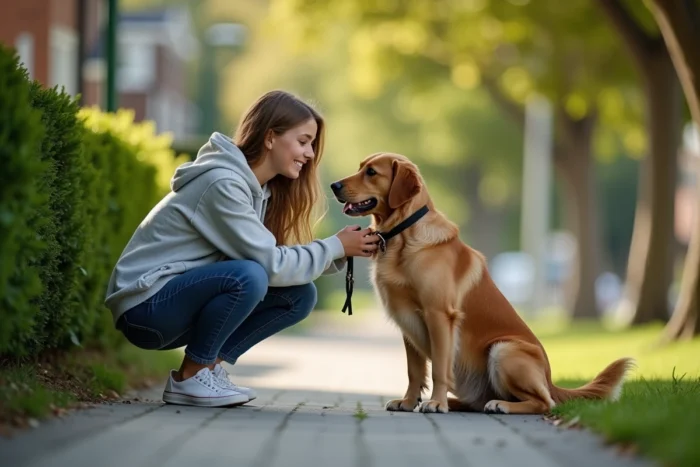
In France, dog-sitting is not reserved for adults. A minor can look after a neighbor’s or a relative’s dog as long as their parents give their consent, but the legal framework varies significantly depending on the age group. The distinction is based on two axes: labor law (from what age a contract is possible) and agricultural regulations that govern any regular activity related to pets.
Civil liability and parental authority: the legal foundation of minor dog-sitting
Before any question of age, the starting point is civil liability. A minor is not legally autonomous. Their parents remain responsible for any damage they cause or suffer while looking after an animal.
In practical terms, if the dog being looked after bites a passerby or damages property, the parents of the minor are held civilly liable. Checking that the family home insurance covers this type of situation is a preliminary step, not an administrative detail.
A written parental agreement is also a basic requirement. Specialized platforms and families that entrust their pet almost systematically ask for authorization signed by a legal representative. To better understand the procedures and do minor dog-sitting with Cani Essence, the regulatory framework is detailed according to each age group.

Dog-sitting before 14 years: what the law really allows
French labor law almost prohibits any paid employment before the age of 14. No contract, no declared remuneration. However, occasional pet care within the circle of acquaintances (neighbors, family, friends) does not fall under the category of salaried work.
A child aged 12 or 13 can walk a neighbor’s dog in exchange for a small compensation, as long as this activity remains occasional, undeclared, and supervised by parents. It is neither employment nor volunteering in the legal sense: it is a tolerated occasional service.
The limits are clear:
- The child cannot register on a pet-sitting platform, as these services require at least being of legal age or having a declared status
- The care cannot involve a dog with behavioral issues (category 1 or 2, reactive dog), as the risk far exceeds what a young teenager can handle
- Hours must remain during the day and the duration limited to a few hours, never a full night
Working from 14 years during school holidays: the legal framework for summer jobs
From the age of 14, the framework changes. A minor can legally work during school holidays, provided that the job is declared, that the parents provide written authorization, and that the employer adheres to limited hours.
For 14-15 year-olds, the employer must also make a prior declaration to the labor inspectorate. The work can only involve light tasks that do not risk harming the health of the young person. Walking a calm dog falls into this category. Looking after a nervous large dog in an isolated house does not.
Paid dog-sitting or service between individuals
In practice, few families enter into a work contract to entrust their dog to a 14 or 15-year-old. The majority of care remains informal. However, the legal difference is real: an undeclared service provides no social protection for the minor in case of an accident.
At 16, the constraints lighten. The minor can work outside school holidays (within the limits of authorized hours) and no longer needs to declare to the labor inspectorate. Dog-sitting then becomes a classic student job activity, comparable to babysitting.

ACACED and declaration at the prefecture: the threshold of 18 years for professional dog-sitting
The clearest boundary is not between 14 and 16 years, but between 17 and 18 years. As soon as an animal care activity becomes regular and paid, it falls under the regulations of the Ministry of Agriculture.
Anyone engaging in a commercial activity related to pets must hold the ACACED (Certificate of Knowledge for Domestic Pet Species). This short training, assessed by an evaluation, is only accessible to adults.
Additionally, one must declare their activity to the Departmental Directorate for the Protection of Populations (DDPP). Without ACACED or declaration, practicing pet-sitting professionally is illegal, regardless of age.
What this means for a 16-17 year old
A 16 or 17-year-old can certainly look after dogs occasionally, in an informal setting or through a job declared by a private employer. What they cannot do:
- Create a self-employed status (prohibited before 18 years unless emancipated)
- Register on certain pet-sitting platforms that require a professional status
- Take the ACACED, reserved for adults, which blocks any regular activity declared to the DDPP
- Look after animals in their own home without declaration, as soon as the activity exceeds the scope of occasional service
Practical skills and canine first aid: what a minor should know before starting
The legal age says nothing about the actual ability to manage a dog. An experienced 15-year-old with animals will be more reliable than an adult who has never had contact with a dog.
Before looking after an animal, even occasionally, some basic skills make a difference. Knowing how to read a dog’s stress signals (repeated yawning, licking of the nose, averting gaze) can help avoid most incidents. Knowing the canine first aid gestures (appropriate lateral safety position, response to heat stroke) provides additional safety.
Some organizations offer introductions to animal care accessible from adolescence, outside the framework of the ACACED. These trainings do not provide professional status, but they reassure owners and train the young person in concrete reflexes.
Minor dog-sitting relies on a balance between strict legal framework and family common sense. Before 14 years, only small local services are realistic. Between 14 and 17 years, the declared occasional job opens up structured possibilities. Transitioning to a professional activity, with ACACED and declaration, remains locked until adulthood.