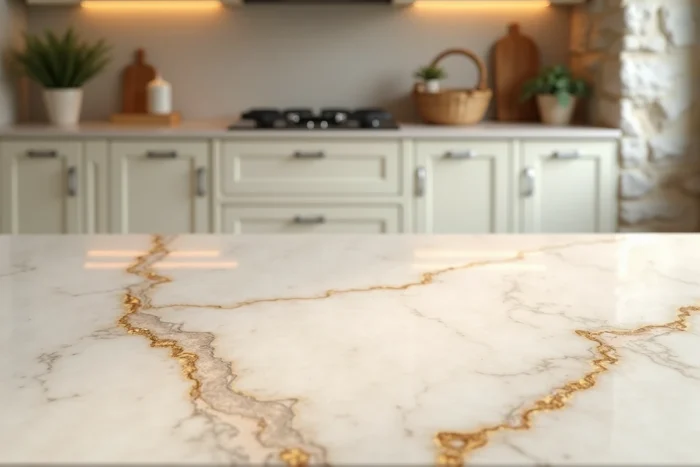
Galala marble is often presented as a marble, but its geological nature is that of a limestone. This distinction changes the interpretation of its technical performance, particularly for projects located in an oceanic climate like that of Morbihan. Water absorption, slip resistance, density: the measurable data of Galala deserve to be compared to those of other common natural stones before validating a choice of covering.
Galala and light natural stones: technical comparison for outdoor use
Terrace, swimming pool beach, or outdoor paving projects near Vannes impose constraints related to humidity, sea spray, and temperature variations. Comparing Galala to other light stones allows for situating its actual performance.
| Criterion | Galala (limestone) | Light travertine | White marble (Carrara) |
|---|---|---|---|
| Geological nature | Sedimentary limestone | Travertine limestone | Metamorphic rock |
| Indicative density | About 2470 kg/m³ | Variable, often slightly lower | Higher on average |
| Water absorption | Measured, suitable for outdoor use with a sanded finish | More porous (natural cavities) | Low, but sensitive to acid stains |
| Slip resistance (sanded/aged finish) | Good, certified for terraces and pools | Acceptable if brushed | Low in polished finish |
| Outdoor use in oceanic climate | Suitable with appropriate finish | Possible but drainage required | Not recommended without treatment |
The density of Galala, around 2470 kg/m³, gives it superior mechanical resistance compared to many travertines. Its porosity, measured in water absorption by weight and volume, remains compatible with outdoor use, provided a sanded or aged finish is chosen to enhance grip.
To delve deeper into the specifics of Galala marble near Vannes, the technical data provided by the product sheets from importers allow for validating the material against local conditions.

Galala outdoors near Vannes: behavior in the Breton climate
The Morbihan coastline combines almost permanent humidity, frequent rains, and salty sea spray. These three factors accelerate the aging of certain natural stones, particularly those whose porosity is not controlled.
Galala, in its sanded finishes and aged edges (tumbled), is explicitly classified for both indoor and outdoor use. Technical sheets mention applications such as terraces, pool surroundings, and bathrooms, which are environments where contact with water is permanent or recurrent.
Porosity and frost resistance
The water absorption of Galala, measured by weight and volume, remains within a range compatible with the moderate freeze-thaw cycles of southern Brittany. Vannes rarely experiences prolonged very low temperatures, which limits the risk of cracking related to the expansion of water in the stone.
On the other hand, a polished finish would be counterproductive outdoors. It reduces surface micro-roughness and increases the risk of slipping on wet slabs. The sanded finish is the coherent technical choice for any paving exposed to Breton rainfall.
Maintenance in a saline environment
Sea spray deposits salts that can create white efflorescence on porous stones. Regular rinsing with clear water is usually sufficient to prevent these deposits on Galala. Water-repellent treatments applied after installation extend the interval between cleanings without altering the natural appearance of the stone.
Galala limestone: why the distinction from marble changes the project
Calling Galala “marble” is a common commercial shortcut. Geologically, it is a sedimentary limestone and not a metamorphic rock. This difference has direct practical consequences on the choice of material and the expectations of the project owner.
- A limestone is easier to work with than true marble, which reduces cutting and shaping costs on site, especially for custom formats.
- Reactivity to acids is more pronounced on limestone: lemon juice, vinegar, or certain household cleaners can dull the surface if not wiped quickly.
- The color palette of Galala (light beige to cream) offers a superior color uniformity compared to most veined marbles, which simplifies the laying of slabs over large areas.
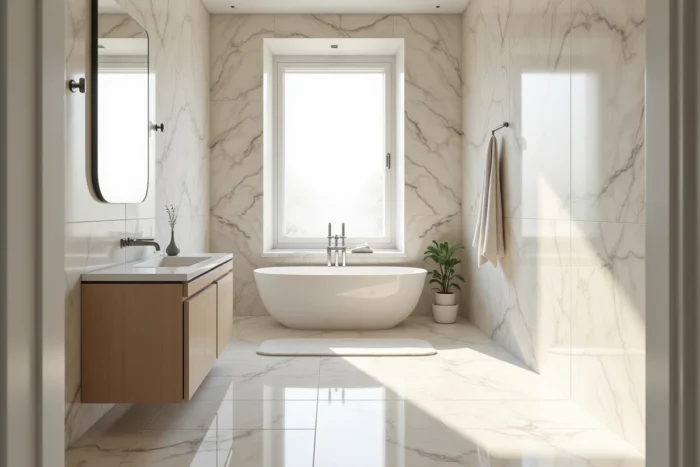
For an interior flooring project (entryway, living room, bathroom), this uniformity allows for achieving a consistent look without having to manually sort each slab. On a veined marble like Carrara, the pattern variations from one slab to another complicate installation and increase the risk of falls.
Selection criteria for Galala for a project in Morbihan
Choosing the right Galala for a project near Vannes requires checking several technical parameters before ordering.
- The finish: sanded or aged for outdoor use, softened or polished for indoor use. This choice affects grip, ease of maintenance, and aesthetic appearance.
- The thickness of the slabs: slabs intended for outdoor pedestrian use require sufficient thickness to withstand mechanical stresses, while wall cladding can suffice with a thinner format.
- Water absorption data: request the technical sheet for the specific batch, as values vary from quarry to quarry and from block to block.
- The origin: Galala is primarily extracted in Egypt. Supply times and transportation conditions to Morbihan influence the project timeline.
The oceanic climate of southern Brittany remains moderate compared to other French regions exposed to prolonged frost. This local climatic data works in favor of Galala, whose frost resistance is suited to mild, humid winters rather than intense cold.
The distinction between limestone and marble, often blurred in commercial discourse, remains the most structuring factor for anticipating the behavior of Galala on a project. It determines the maintenance precautions, suitable finishes, and the actual durability of the covering.