
The engine light comes on, the diagnostic tool displays a six-digit manufacturer code, and doubt sets in. On Renault diesel engines, the DTC038061 points to the glow plug circuit, but not exactly in the way most guides describe. Understanding what this code really indicates helps avoid unnecessary part replacements.
DTC038061 Renault and generic code P0380: two readings of the same fault
When a standard OBD-II diagnostic tool scans a K9K 1.5 dCi engine, it often translates the fault into the generic code P0380 (“Glow Plug/Heater Circuit A Malfunction”). The information is correct but incomplete.
Internally, Renault uses its own nomenclature. The manufacturer code DF025, corresponding to the dtc038061 Renault code, does not simply refer to a burnt-out glow plug. Its official wording describes a break in the glow plug diagnostic circuit, which includes the plugs, the relay, the wiring harness, and the connection to the engine control unit.
This distinction has a direct practical consequence. Replacing all four glow plugs without checking the rest of the circuit is like treating a symptom without looking for the cause. The control unit monitors the entire chain, not just the resistance of a single plug.
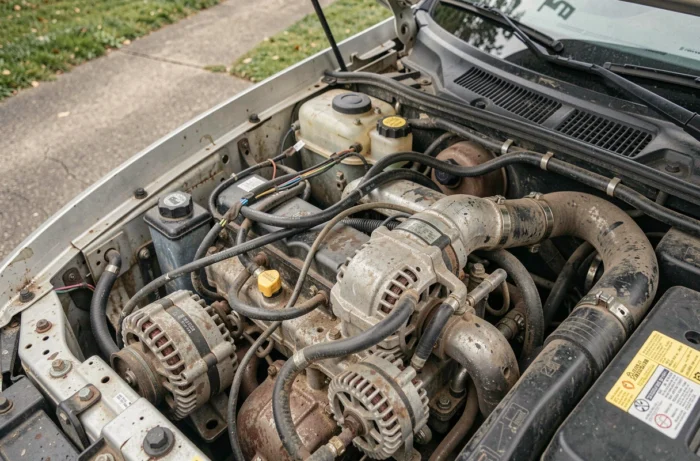
Diesel glow plug circuit: what the control unit really monitors
Have you ever noticed that the glow plug light (the spiral on the dashboard) stays on for a few seconds before a cold start? During this time, the engine control unit sends current to the glow plug relay, which powers the plugs. Each plug heats the combustion chamber of its cylinder to facilitate the ignition of the diesel.
The system does not just send current. The control unit measures the electrical consumption of the circuit in return. If the value does not match what it expects (too low, too high, or absent), it registers a fault.
Specifically, the DTC038061 can trigger in several situations:
- A broken or short-circuited glow plug, which alters the total resistance of the circuit as seen by the control unit.
- A glow plug relay that no longer switches correctly, preventing the plugs from receiving power even if they are in good condition.
- An oxidized or cut wire in the wiring harness between the relay and the plugs, creating an intermittent fault that the driver perceives as random.
- A poor ground contact on the engine block, sufficient to skew the control unit’s measurement without any part actually failing.
The Renault technical documentation also distinguishes P0380 (DF025, diagnostic circuit) from P0382 (DF017, relay control). This separation means that the relay and the monitoring circuit are treated as two distinct faults. Mixing the two leads to erroneous diagnostics.
Diagnosing DTC038061 with a multimeter: where to start
Before disassembling anything, a basic multimeter and a visual inspection are enough to guide the diagnosis in the right direction.
Check the power supply voltage at the relay
With the engine cold and the ignition on (preheating position), measure the voltage at the terminals of the glow plug relay. You should find battery voltage (around 12 volts). If the voltage is absent, the problem lies upstream: blown fuse, cut wire between the battery and the relay, or control unit command fault.
Test each glow plug individually
Disconnect the connector from each plug. Set the multimeter to resistance mode (ohms). A functional glow plug shows a very low resistance, on the order of a few ohms. An infinite value indicates a broken plug. An abnormally low value may indicate an internal short circuit.
Test all four plugs. The control unit detects an overall discrepancy in the circuit, so a single faulty plug is enough to trigger the code.
Inspect the wiring harness and grounds
Oxidation of connectors is a common cause in vehicles over a few years old, especially in humid areas. Visually check the condition of the terminals on each plug and on the relay. Cleaning with fine sandpaper and applying dielectric grease sometimes resolves an intermittent fault without needing to replace any parts.

Common mistakes when repairing the Renault glow plug system
The most common trap is replacing the plugs in bulk without having identified the real cause. If the relay is faulty, the new plugs will not receive current, and the code will reappear on the first cold morning.
Another classic mistake: forcing the removal of a stuck plug in the cylinder head. On diesel engines, glow plugs are exposed to high temperatures and carbon deposits. A broken plug in its housing turns a simple repair into a heavy intervention, sometimes requiring tapping or specialized extraction. Applying a penetrating oil the night before and using a gradual loosening torque significantly reduces this risk.
Lastly, a point often overlooked: after replacing parts, the fault code must be cleared with a diagnostic tool, and a cold start cycle should be performed to check that the control unit does not re-register DTC038061. A simple clearing without validation testing confirms nothing.
Glow plug systems remain relatively accessible on most K9K engines. Correctly identifying whether the fault comes from a plug, the relay, the wiring harness, or a ground avoids multiplying replaced parts. A multimeter, a bit of method, and the correct reading of the manufacturer code make the difference between effective diagnosis and unnecessary bills.