
When SP95-E10 exceeds 2 euros per liter at the station, every fill-up makes you wonder if you’re putting the right fuel in your tank. Choosing the right fuel isn’t just about going for the cheapest option: it affects combustion, actual consumption, and engine lifespan. Here’s how to decide based on your vehicle and daily use.
Octane rating and gasoline engines: what the flap doesn’t always tell you
You open the fuel flap, read “Unleaded 95 minimum,” and fill up. The problem is that this indication sets a minimum, not an optimum. A turbocharged direct injection engine, even if it accepts SP95-E10, can achieve better efficiency with SP98.
The octane rating measures the fuel’s resistance to knocking. The higher it is, the more consistent the combustion remains under high load. On a highway trip or during prolonged climbs, SP98 reduces the risk of knocking in turbo engines. In calm urban driving, the difference remains negligible.
Specialized platforms like CarburAuto allow you to compare prices station by station and weigh the extra cost of SP98 against the comfort gain for your typical journey.
However, putting SP98 in an engine designed for SP95-E10 without a turbo doesn’t provide any measurable benefit. You pay more for no gain. The manufacturer’s recommendation in the maintenance booklet remains the basis for any choice.
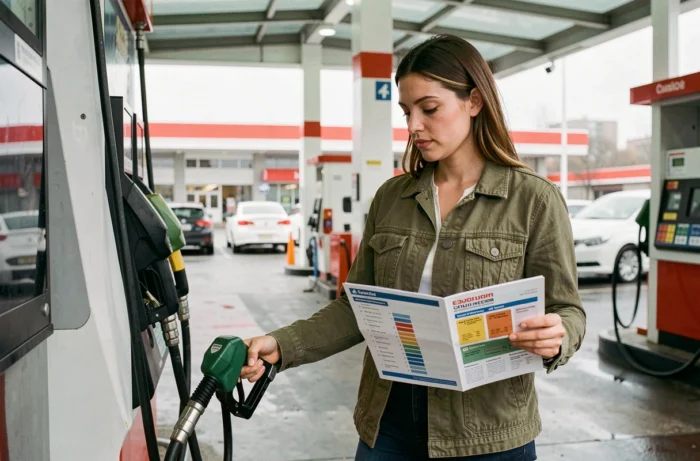
SP95-E10 or classic SP95: the ethanol content changes the game
SP95-E10 contains up to 10% ethanol, compared to 5% for classic SP95. This difference may seem minimal, but it has two concrete consequences.
Ethanol has a lower calorific value than pure gasoline. In practice, consumption slightly increases with a fuel higher in ethanol. With a full tank, you may lose a few dozen kilometers of range compared to SP95 without E10.
The other point concerns compatibility. Almost all gasoline vehicles put on the road since 2000 accept SP95-E10. For older models, particularly some engines from the 1990s, untreated rubber seals and hoses may degrade with prolonged contact with ethanol. Checking the manufacturer’s compatibility list before switching avoids an unpleasant surprise.
And is E85 profitable for everyone?
E85 has a significantly lower price than other gasoline. The temptation is strong. But you need either a factory flex-fuel vehicle or an approved conversion kit. Without an approved kit, E85 damages the injectors and valves of a conventional gasoline engine.
With a kit, the overconsumption typically reaches 20 to 25% compared to SP95-E10, which eats into some of the savings at the pump. For high-mileage drivers exceeding 15,000 km per year, the calculation remains advantageous. For limited urban use, feedback varies on this point and heavily depends on the local price of E85.
B7 diesel and diesel: why cost per kilometer is no longer enough
Diesel has long been the king of fuels in France due to a lower price per liter and lower consumption on the highway. The trend has reversed. By the end of August 2026, according to BFMTV, diesel reached an average national price of 2.247 euros per liter, making it more expensive than SP95-E10 at 2.024 euros per liter.
Diesel remains relevant for high-mileage drivers exceeding 20,000 km per year, especially on roads and highways. The consumption of a modern diesel engine remains lower than that of a comparable gasoline engine on long trips. In the city, the situation changes: traffic restrictions in low-emission zones (ZFE) are gradually excluding older diesels, and maintaining the particulate filter adds a cost that is often underestimated.
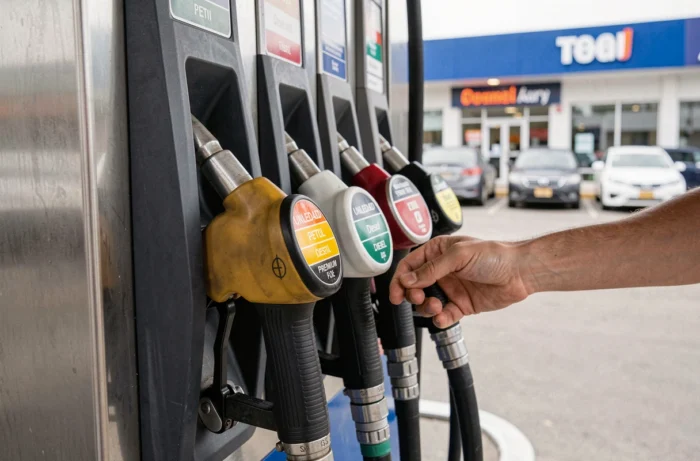
Maintenance of the diesel injection system
A modern diesel engine (common rail high pressure) does not tolerate poor quality diesel well. Piezoelectric injectors are sensitive to impurities. Opting for branded diesel with detergent additives protects the fuel system in the long term. The extra cost of a few cents per liter can be recouped by extending the replacement interval for injectors, whose unit price often exceeds several hundred euros.
Concrete criteria for choosing your fuel based on usage
Rather than listing generalities, here are the parameters that truly weigh in the decision:
- Annual mileage: below 12,000 km, a gasoline engine with SP95-E10 offers the best cost/maintenance compromise. Beyond 20,000 km mostly on the road, diesel retains a consumption advantage despite its high price per liter.
- Type of trips: short urban journeys degrade diesel engines (clogging of the particulate filter) and negate their consumption advantage. Gasoline or E85 with a kit are better suited to this profile.
- Age and engine type of the vehicle: a naturally aspirated engine without a turbo gains no benefit from SP98. A recent turbocharged engine with a high compression ratio does, especially in sporty or loaded driving.
- Traffic zone: in ZFE, a Crit’Air 3 or older diesel will soon be banned. This parameter weighs as much as the fuel price in the choice of a vehicle.
It always comes back to the same point: the best fuel is the one that matches both the engine installed under the hood and the actual use of the vehicle. A premium SP98 in a naturally aspirated city car that drives 8,000 km per year in the city is wasted money. An SP95-E10 in a high-performance turbo engine used on the highway is a compromise that deserves questioning.
The manufacturer’s maintenance booklet, the expected mileage, and the local pump price form the decision triangle. Everything else is marketing.