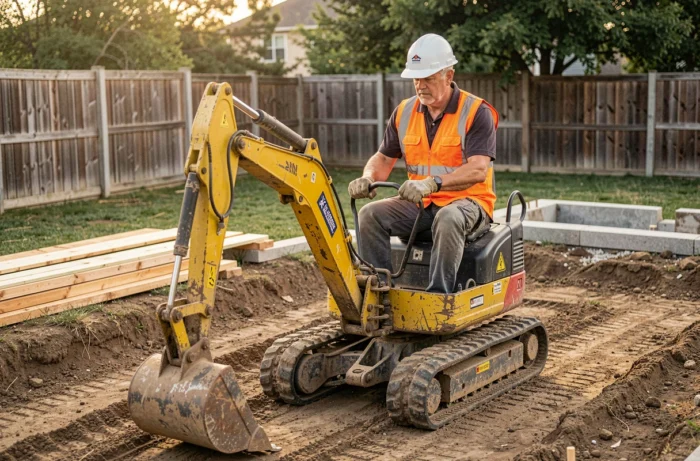
Excavating a terrace means removing a layer of soil to create a stable base before laying slabs, gravel, or a concrete slab. The choice of machine for excavating a terrace depends on three measurable variables: the area to be treated, the depth of excavation, and access constraints to the site.
Comparing these parameters before renting or purchasing helps avoid extra costs associated with oversized machinery or, worse, equipment that is too weak, which prolongs the project.
Machine weight and passage width: the two filters that eliminate half the options
Before looking at brands or rental prices, two physical data points drastically reduce the list of machines compatible with your terrain. The first is the width of the access passage (gate, side path, space between the house and the fence). The second is the load-bearing capacity of the existing soil, directly related to the weight of the machine.
A mini-excavator weighing less than one ton can pass through a standard 90 cm gate. Beyond 1.5 tons, an access width of at least 1.20 m is generally required. For machines weighing 2.5 to 3 tons, plan for a clear passage of about 1.50 m, including tracks.
If the excavation is located at the back of the garden behind the house, with no direct access from the street, a compact rubber-tracked machine is often the only viable option. Also, check that the ground between the entrance and the work area can support the weight: a waterlogged lawn can turn into a quagmire under a 2-ton mini-excavator.
Choosing the right machine for terrace excavation starts with a tape measure, not an online catalog.
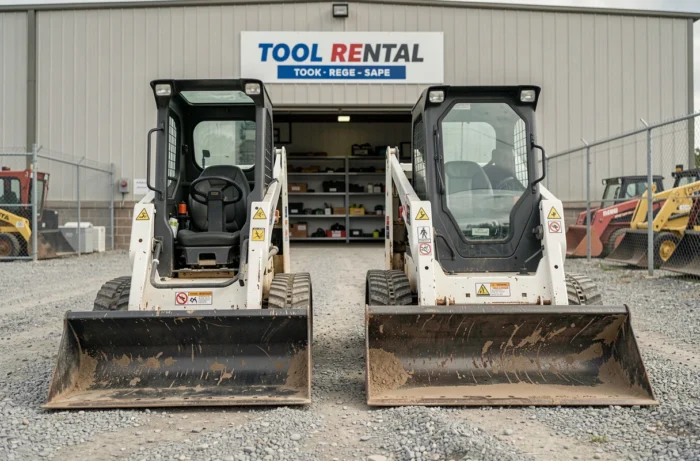
Comparison of excavation machines for a private terrace
The table below contrasts the three most commonly used categories of equipment for excavating soil before constructing a terrace. The cost data comes from pricing grids published by rental companies and public works firms in 2026.
| Criterion | Tiller / cultivator | Mini-excavator under 1.5 t | Mini-excavator 1.5 to 3 t |
|---|---|---|---|
| Excavation depth | Superficial loosening (less than 20 cm useful alone) | Up to about 1.50 m | Up to about 2.50 m |
| Suitable area | Less than 10 m² | 10 to 40 m² | More than 40 m² |
| Required passage width | Less than 60 cm | About 90 cm to 1.20 m | 1.20 m to 1.50 m |
| Rental without driver (price range/day) | 50 to 80 euros | 150 to 200 euros | 200 to 250 euros |
| With driver (price range/day) | Not applicable | 450 to 600 euros | 450 to 700 euros |
| Required driving level | None | Basic training recommended | Experience or CACES advised |
The tiller does not excavate in the strict sense: it loosens the soil at the surface. Removal remains manual, using a shovel and wheelbarrow. For a terrace of a few square meters on loose soil, this approach works. Beyond that, the working time skyrockets.
Rental with or without a driver: actual cost beyond the daily rate
Comparing the daily rental price alone with that of the service including a driver is not enough. A private individual often spends two to three times more machine time than a professional for the same excavation, according to feedback from public works companies published in 2026.
This time differential has three direct consequences:
- The number of rental days increases, which reduces or cancels the initial savings compared to the option with a driver.
- Fuel consumption rises proportionately, a cost often underestimated as it is billed in addition to the rental.
- The risk of breakage or damage to the terrain increases with the hours of handling by an untrained operator, and the deposit may suffer.
For a standard terrace excavation (about twenty square meters at a depth of 25 to 30 cm), an experienced driver can complete the work in half a day with a 1.5-ton mini-excavator. A private individual will often spend a full day, or more if they also need to load debris into a dumpster.
The actual cost of renting without a driver includes towing, fuel, deposit, and lost time. Adding these items before deciding often changes the conclusion.
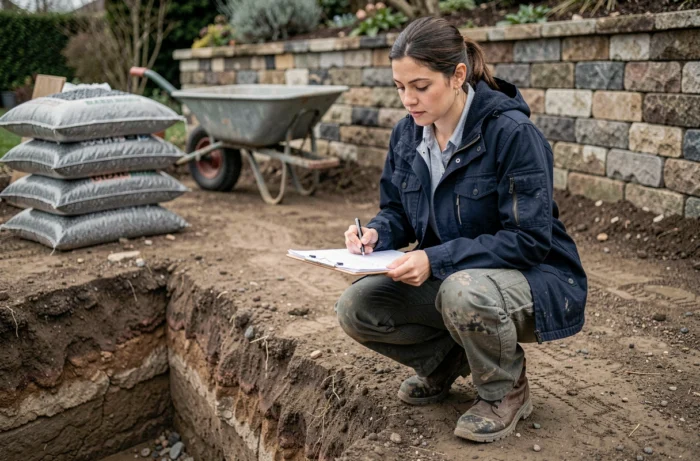
Soil type and depth: adapting the bucket and power to the terrain
A compact clay soil does not excavate like a sandy fill. The nature of the terrain dictates the choice of bucket (smooth for clay, toothed for stony soils) and the hydraulic power required.
For a terrace, the excavation depth varies depending on the planned covering. A terrace on pedestals requires less excavation than a concrete slab poured on a gravel bed. In the latter case, enough material must be removed to accommodate the gravel bed, the mesh, and the thickness of the concrete, which is commonly 25 to 35 cm in total.
- Loose soil (topsoil, sand): a mini-excavator under one ton is sufficient, the standard bucket is suitable.
- Dense clay soil: plan for a mini-excavator of at least 1.5 tons with a smooth cleaning bucket to avoid clogging.
- Soil with stones or old foundations: a toothed bucket and a machine of at least 2 tons reduce blockages and project time.
The swelling of the excavated soil increases the volume to be removed by about a quarter to a third compared to the in-situ volume. Planning for the dumpster accordingly avoids a second trip from the truck.
Noise in urban areas: a regulatory constraint strengthened in 2026
A circular regarding the management of the noise directive 2002/49/CE, which came into effect on August 5, 2026, strengthens the regulation of noise nuisances in urban areas. For terrace excavation in a housing estate or city center, this translates into stricter working hours and increased attention from neighbors and municipalities.
Recent mini-excavators compliant with Stage V standards generate less noise than older models. When renting, checking the year of manufacture and engine standard allows for anticipating this point. A quieter machine sometimes allows for a wider working time frame, which offsets a potential rental cost increase.
The sizing of the machine, the rental mode, and the nature of the soil form a decision triangle. Measuring access, estimating the actual volume after swelling, and comparing the total cost with and without a driver: three concrete checks that fit on a sticky note but can prevent an additional dumpster bill.