
The unique school booklet (LSU) is the national application that centralizes periodic assessments and end-of-cycle evaluations for each student, from CP to third grade. In the Versailles academy, its use relies on authentication via the ARENA portal and synchronization with the student database. For school principals, the LSU is not just a simple record of grades: it is a tool for educational monitoring and transmission between cycles.
Recently, it has also served as a lever for territorial management.
Coupling LSU and ADAGE: the school booklet becomes a tool for territorial management
Competitors mainly detail the technical access to the LSU or the difficulties of data entry. A more recent aspect deserves the attention of principals: the gradual integration between the LSU and the ADAGE platform, dedicated to artistic and cultural education pathways (EAC).
Specifically, EAC actions (cultural outings, workshops, partnerships with local structures) now directly feed into the student’s school booklet. The school principal no longer has to manually collect this information from each teacher to link it to the student’s pathway.
To delve deeper into the procedures specific to this academy, a detailed guide on the LSU in the Versailles academy explains how to articulate these different data flows on a daily basis.
This interconnection changes the very nature of the LSU. It shifts from a simple evaluation booklet to a tool for enhancing the overall student pathway. For the Versailles rectorate, the LSU-ADAGE crossover also serves as a consolidated indicator to measure the generalization of EAC in the academic territory.
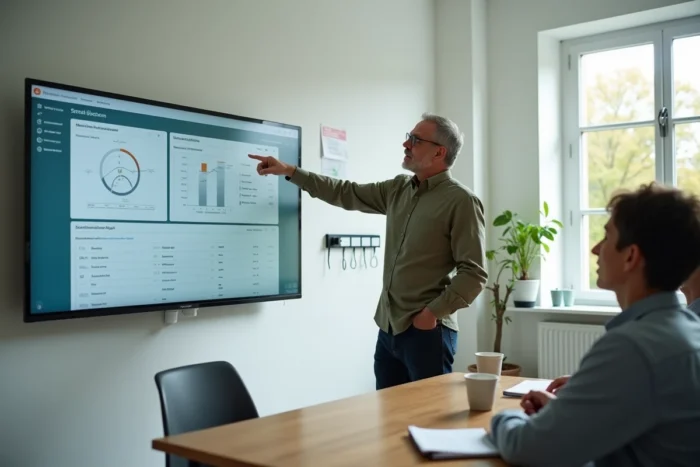
Role of the school principal in the daily management of the LSU
The school principal occupies a unique position in the LSU circuit. They are not just a simple user: they are responsible for the consistency of the data entered by the entire teaching team at their school.
Configuration and verification of structures
Before each data entry period, the principal must ensure that the school’s structure (classes, levels, distributions) corresponds to what is recorded in the student database. A discrepancy between the two causes display errors or access issues for teachers.
Any structural modification in the student database must precede data entry in the LSU. In practice, principals who perform this check before each end of period avoid most of the technical incidents reported by their colleagues.
Locking and transmission of assessments
The principal is the only one who can lock the periodic assessments, which triggers their availability to families via EduConnect. This locking is irreversible for the concerned period. Three checks are necessary before validation:
- All areas of the common core have received a positioning for each student, with no empty fields indicating a data entry oversight
- The general comments written by teachers are reviewed to detect any inconsistencies or ambiguous wording
- Students who arrived during the period are correctly placed in the right class group, and their assessment reflects their actual duration of attendance
Once the locking is done, parents can access the assessments within a few hours. The principal has no means to correct a locked assessment without going through a unlocking procedure with academic support.
Academic orientations 2026-2027 and evolution of the LSU in Versailles
The academic orientations for 2026-2027 place the LSU within a logic that goes beyond the usual pedagogical framework. Three official objectives structure this evolution: placing EAC at the heart of learning, mobilizing dedicated networks, and generalizing the project approach.
For school principals, this translates into an additional responsibility. The LSU becomes a support for reporting on projects conducted in the school, not just a tool for recording academic results. A principal managing a cultural project with a partner structure must now ensure that this project is properly reflected in ADAGE, and then in the LSU of each concerned student.

Continuity of service and feedback
The Public Services+ portal has relayed user feedback regarding maintenance periods of the LSU. These interruptions, often concentrated at the end of the term, pose a concrete problem for principals who work under time constraints.
Planning data entry and locking several days before the deadline remains the only reliable solution. Principals who wait until the last day expose themselves to unexpected maintenance windows, with no recourse available.
LSU and inter-cycle transmission: what the principal must anticipate
When a student leaves elementary school for middle school, their LSU automatically follows. The end-of-cycle 2 assessment (CE2) and the end-of-cycle 3 assessment (CM2 or sixth grade) constitute the documents transmitted to the secondary education teams.
The school principal has every interest in verifying the completeness of these cycle assessments before the students depart. An incomplete assessment does not block the transfer, but it deprives the middle school team of useful information for welcoming the student. The incomplete end-of-cycle assessments are visible to the receiving middle school, which can generate requests for additional information in September, at a time when the principal is already managing the start of the school year.
The verification also focuses on the consistency between the common core positionings and the written comments. A student positioned as “objectives achieved” in all areas but whose comments indicate persistent difficulties sends a contradictory signal to the receiving team.
The LSU in the Versailles academy is moving towards an expanded role, balancing individual educational monitoring and academic management tool. For school principals, technical mastery of the application is no longer sufficient: it is the rigor in configuration, control before locking, and articulation with new platforms like ADAGE that makes the difference on a daily basis.