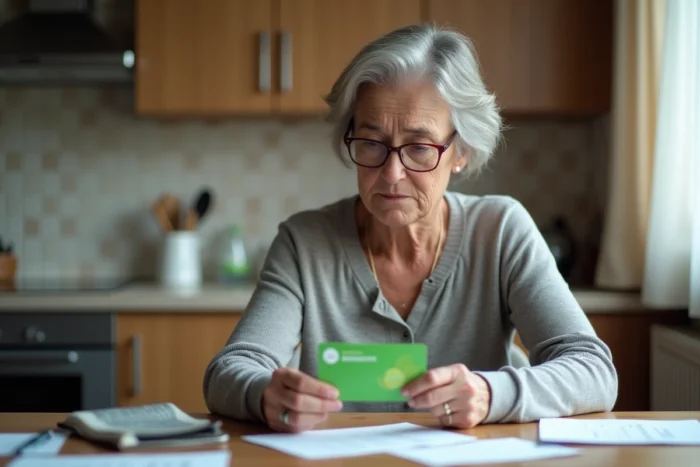
We have just received the letter confirming the agreement of the ALD, we go to the pharmacy or to a specialist, and there, the pharmacist or the practitioner announces that nothing shows up in their software. The Vitale card does not mention any exemption. As a result: we pay the fees upfront, we leave with an out-of-pocket expense that we should not have to bear. This scenario occurs very often, and the causes are rarely explained clearly by the CPAM.
Validated care protocol but silent Vitale card: what blocks at CPAM
The attending physician has filled out the care protocol, the CPAM has given its approval, and yet the Vitale card remains unchanged. The problem lies in the internal circuit of the Health Insurance. The medical agreement (medical-administrative section) and the updating of rights in the computer system are two distinct steps, handled by different services.
In practical terms, the exemption from the co-payment must be entered into the ADRI system (online rights consultation) for healthcare professionals to see it appear when they swipe the Vitale card. As long as this entry is not effective, the practitioner’s software displays a patient without an exemption, even if the agreement letter exists.
The delay between the agreement and the encoding in the system varies. Some insured individuals notice a lag of a few days, while others wait several months. There have been testimonies where the situation remained blocked for over a year, forcing the patient to pay for their treatments even though the ALD had been granted. If one wonders why my ALD does not appear on the Vitale card, the answer often lies in this administrative lag between medical validation and computer encoding.
Exempt ALD and non-exempt ALD: real impact on the Vitale card
Not all ALDs result in a visible mention on the Vitale card, and this distinction is poorly understood.
- Exempt ALDs (list of pathologies recognized by the Social Security Code, plus diseases requiring costly treatment for more than six months) entitle the patient to 100% coverage based on the conventional rate. The exemption from the co-payment should normally appear in the patient’s rights, which can be consulted via the ADRI system.
- Non-exempt ALDs correspond to conditions requiring a work stoppage or prolonged care beyond six months, but without exemption from the co-payment. In this case, no specific mention appears on the Vitale card or in the practitioner’s software.
- Some sensitive pathologies (psychiatry, HIV, for example) are subject to special treatment regarding confidentiality: the CPAM may voluntarily choose not to include the ALD on the certificate or card, to protect the patient’s privacy. This is indeed what several insured individuals report when they receive a letter indicating that the ALD “will not appear”.
Before making any claims, it is essential to check what type of ALD one falls under. A non-exempt ALD does not trigger any visible exemption on the Vitale card.

Unlocking the situation: effective steps with the CPAM
When the exempt ALD is indeed granted but the card remains silent, we have several concrete levers. The order in which we act matters.
Update the Vitale card at a terminal or online
First reflex: swipe the Vitale card at an update terminal, in a pharmacy or at a CPAM reception. If the exemption has been encoded in the meantime, the card updates within seconds. This step costs nothing and resolves the issue in simple cases.
Request the rights certificate on the Ameli account
On the Ameli account, the rights certificate mentions the exemption from the co-payment when it is active. If the downloaded certificate does not indicate any exemption despite the agreement received by mail, the blockage is confirmed on the encoding side. Printing this certificate and presenting it to the healthcare professional does not always suffice: some software does not allow for manual enforcement of full third-party payment without the ADRI system confirming the exemption.
Contact the CPAM in writing with the protocol number
A phone call rarely yields a definitive result. The most effective approach remains a written message via the Ameli account messaging system, attaching a copy of the agreement letter and citing the care protocol number. One explicitly requests the entry of the exemption into the rights system.
If the response is delayed or if the CPAM refers to another service, filing a formal complaint via the Public Services+ portal (formerly “Your Rights Plus”) speeds up processing. Several insured individuals who were blocked for months obtained regularization after this report.
Reimbursement of fees paid during the blockage
During the entire period when the exempt ALD was granted but not visible, the care related to the condition should have been covered at 100% of the conventional rate. Therefore, one has the right to request a retroactive reimbursement of the co-payments paid.
To do this, one gathers the invoices, the reimbursement statements from the Ameli account, and the ALD agreement letter. All of this is sent to the CPAM via the secure messaging system, specifying the dates of the relevant care. The CPAM must regularize reimbursements from the effective date of the ALD, not from the date of the card update.
Responses vary on this point: some insured individuals receive an additional transfer within weeks, while others need to follow up. The complementary mutual insurance, for its part, may have advanced part of the co-payment. In this case, the regularization occurs between the CPAM and the complementary health insurance, without any further intervention from the patient.
ALD reference nurse: a recent relay for blocked situations
Since May 2026, individuals with exempt ALD can designate a reference nurse with the Health Insurance. Their role goes beyond care: they coordinate the pathway, verify the continuity of care, and can intervene when an administrative problem (unrecognized prescription, refused medical transport, absent exemption) blocks access to care.
This system does not directly resolve the display bug on the Vitale card, but it creates a field contact capable of escalating the issue in ways other than going through the CPAM’s phone line. For isolated patients or those uncomfortable with digital procedures, this option should be activated as soon as the ALD is recognized.
The key point to remember: an ALD granted but invisible on the Vitale card is not a fatality. The blockage is almost always administrative, never medical. By precisely identifying the source of the lag and formalizing the request in writing, regularization eventually occurs, including for already incurred expenses.