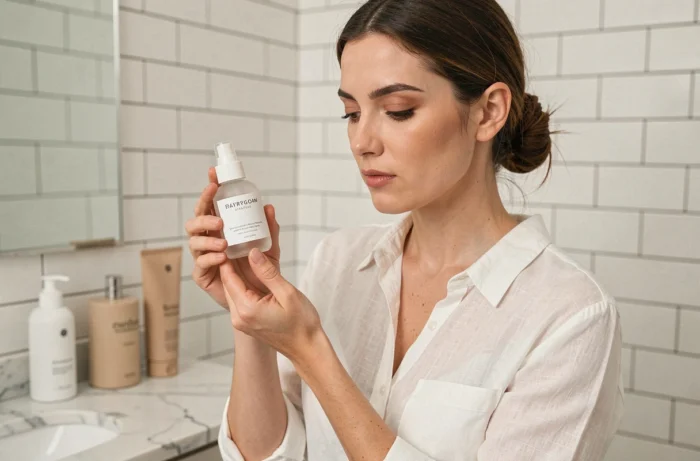
Typology has become one of the most sought-after skincare brands in France in just a few years. Its short formulas, sleek bottles, and accessible prices attract a clientele that values transparency. However, it is impossible to find it at Sephora, neither in-store nor on the brand’s website. This is not an oversight; it is a strategic choice made by the Parisian brand.
Typology’s direct-to-consumer model excludes traditional retailers
Typology was founded in 2019 by Ning Li with a simple idea: to sell its products directly to consumers, without intermediaries. This model, called direct-to-consumer, means that the brand controls the entire chain, from manufacturing to delivery.
Going through a distribution network like Sephora’s involves giving up a margin to the retailer. By remaining independent, Typology freely sets its prices and maintains its profitability without raising prices for the end customer.
This choice goes beyond mere economics. If you are looking for where to buy Typology in stores, the answer remains very limited: the brand only has a corner at Printemps Haussmann in Paris and prioritizes sales on its own website. Typology deliberately refuses chain distribution in perfumeries.
This positioning also protects the brand image. At Sephora, a Typology serum would be alongside hundreds of competing references. Online, the brand controls the shopping experience from start to finish: personalized skin diagnostics, detailed product sheets, and unfiltered communication with its community.
Sephora and Typology: two visions of beauty that do not align
Have you noticed that Sephora promotes its own programs, like its “Clean at Sephora” selection? The retailer imposes specific criteria on partner brands. It also negotiates exclusives, in-store promotions, and specific formats.
Typology builds its identity on simplicity and total transparency. Its formulas display the exact concentration of each active ingredient, sometimes limited to fewer than ten ingredients. This minimalist philosophy clashes with the operation of a selective retailer that manages thousands of references and guides consumers through rankings, promotions, and merchandising.
For Sephora, integrating a brand implies a shared logistical and marketing investment. The brand must agree to comply with the store’s rules: shelf placement, participation in promotional activities, sharing customer data. Typology has built its growth on a direct relationship with its buyers and data collection through its online diagnostics. Entrusting part of this relationship to a third party would go against its model.
The issue of margins and pricing positioning
Brands distributed at Sephora incorporate the distributor’s commission into their selling price. Typology offers serums and skincare at prices considered accessible for the concentrated active cosmetics segment. Accepting the distributor’s margin would either require raising prices or reducing quality.
Neither option aligns with the brand’s positioning. This economic calculation alone explains much of the absence in selective perfumeries.
European regulation and clean beauty: a context that reinforces Typology’s choice
The cosmetics market in Europe is undergoing a phase of regulatory tightening. The new European rules on environmental claims push brands to clarify their commitments and prove their labels. An analysis from 2026 indicates that this regulatory pressure has caused a significant increase in sales of certified clean beauty products in France.
Sephora adapts its programs accordingly and strengthens its requirements for partner brands. For Typology, which already claims formulas without controversial ingredients and transparent labeling, going through an intermediary does not add value in this area. The brand communicates directly about the composition of each product via its website and app.
This regulatory context benefits brands capable of proving their commitments without relying on a third-party label imposed by the distributor. Typology prefers to manage this communication itself rather than delegate it to a program like “Clean at Sephora”.
What the digital model allows in terms of traceability
By selling exclusively (or almost) online, Typology can:
- Display the complete list of ingredients with their exact percentages, exceeding the usual legal obligations in-store
- Offer an online skin diagnosis that directs customers to suitable products, replacing in-store advice
- Instantly update product information in case of reformulation or supplier change
This level of detail would be impossible to reproduce on a shelf label at Sephora. The official website replaces the beauty advisor and the informative packaging.

Typology in-store: the Printemps Haussmann corner as a strategic exception
Typology has not completely given up on physical retail. The brand has a corner at Printemps Haussmann, Boulevard Haussmann in Paris. This choice is not trivial: a department store offers a more selective environment than a chain of perfumeries, with a targeted clientele and a premium positioning.
This unique point of sale serves several objectives:
- Allow customers to test textures and fragrances before buying online
- Enhance brand awareness among an international clientele passing through Paris
- Maintain total control over product presentation and brand messaging
One physical point of sale is enough to create an event without diluting the brand image. Multiplying retailers would cause Typology to lose what makes it unique: controlled rarity.
The brand has also conducted occasional operations, such as a partnership with the concept store Merci in Paris. These ephemeral collaborations maintain curiosity without engaging Typology in a permanent distribution network.
The absence at Sephora is therefore not due to a lack of resources or a refusal of the retailer. It is a decision consistent with a business model designed from the outset to operate without intermediaries. As long as online sales continue to drive Typology’s growth, there are few reasons for this strategy to change.