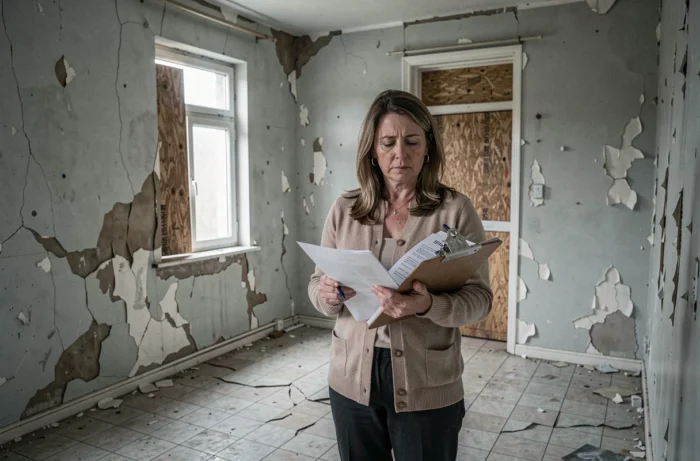
The property tax remains due even when a dwelling is empty, unless the owner demonstrates that the property is objectively uninhabitable. The tax administration distinguishes between voluntary vacancy and involuntary vacancy, and this distinction determines access to the relief provided by Article 1389 of the General Tax Code. Measuring the gap between what the tax authorities require as evidence and what property owners typically provide helps to understand why so many requests fail.
Online declaration on impots.gouv.fr: an underutilized digital trace
Since 2023, every owner must declare the occupancy status of each of their properties via the “Manage my real estate” service on impots.gouv.fr. This update is mandatory each year before June 30 in case of changes (change to vacant housing, disaster, etc.).
An inaccurate or absent declaration exposes the owner to a fine of 150 euros per property. What many property owners do not realize is that this obligation creates a timestamped digital trace. Explicitly mentioning “vacant unit” in the online space constitutes a supplementary piece of evidence when applying for property tax relief or contesting TLV/THLV.
To justify the uninhabitability of a house, this declaration alone is not sufficient, but it provides a dated administrative foundation that the administration can cross-reference with other documents in the file.
Conditions for property tax relief: comparative table of criteria
Article 1389 of the CGI sets three cumulative conditions. The table below contrasts these legal requirements with common errors in property owners’ requests.
| Legal criterion | What the administration expects | Common owner error |
|---|---|---|
| Vacancy independent of the taxpayer’s will | Proof of a suffered event (disaster, emergency order, structural degradation) | Citing the absence of a tenant without demonstrating the material impossibility of occupation |
| Minimum duration of three consecutive months | Documents dated covering the period (reports, invoices, insurance correspondence) | Providing photos without date or usable temporal context |
| Vacancy affecting the entire property or a part that can be rented separately | Precise description of the affected rooms or areas | Requesting relief for a partially occupied dwelling without justifying functional separation |

The gap between the second and third columns explains the majority of rejections. The owner reasons in terms of personal situation, while the administration reasons in terms of objective documentary evidence.
Acceptable evidence for uninhabitability: what tips the balance in a case
The strongest case combines several types of documents that corroborate each other. A single isolated element rarely suffices to convince the public finance center.
- A bailiff’s report (judicial officer) describing the condition of the property with dated photographs. This document has greater evidential value than personal photos because it is prepared by an official officer.
- An expert report (judicial expert, building expert) or a technical diagnosis establishing that the dwelling does not meet the criteria of decency or safety, for example in cases of heating failure, dangerous electrical installation, or compromised load-bearing structure.
- Detailed and dated quotes or invoices for repair work, showing that rehabilitation requires heavy interventions incompatible with immediate occupation.
- A municipal order of peril or unsanitary conditions, which constitutes the strongest evidence as it comes from a public authority and formally prohibits occupation of the property.
- Insurance correspondence or reports in case of disaster (fire, major water damage, natural disaster), which establish both the cause and the timeline of uninhabitability.
The combination of a bailiff’s report and a quote for heavy work forms the minimal credible foundation for an owner without a peril order.
Documentary traps to avoid
Simple sworn statements from the owner have no evidential value for the administration. Similarly, photos taken on a phone without exploitable metadata are regularly dismissed.
A file that mixes documents concerning different periods without a clear chronology weakens the request. Each document must exactly cover the period of vacancy claimed, with consistent dates among them.
Claim to the public finance center: deadlines and procedure
The claim must be addressed to the public finance center to which the property belongs. The maximum deadline runs until December 31 of the year following the year in which the vacancy reaches three months. After this deadline, the request is inadmissible, even with a solid file.
The claim takes the form of a reasoned letter, accompanied by all supporting documents. Explicitly mentioning Article 1389 of the CGI in the letter immediately directs the processing to the correct legal framework.
In case of rejection, the owner has recourse to the administrative court. Case law shows that judges systematically check whether the vacancy is truly involuntary and whether the evidence adequately covers the minimum duration of three months.
Particular case of declared disasters
When a fire or natural disaster renders a dwelling uninhabitable, the tax administration has already accepted the principle of automatic relief in certain localized situations. However, outside these exceptional provisions, the affected owner must compile their claim file according to the standard procedure, even if the cause of uninhabitability seems obvious.
The relief applies to the actual period of uninhabitability, calculated proportionally to the number of months concerned. It only covers property tax, not the tax on vacant housing, which falls under a separate regime with its own exemption conditions.
The difference between an accepted file and a rejected file rarely lies in the substance of the issue. Most of the affected dwellings are indeed uninhabitable. What makes the difference is the documentary rigor: dated, coherent evidence that precisely covers the declared vacancy period.