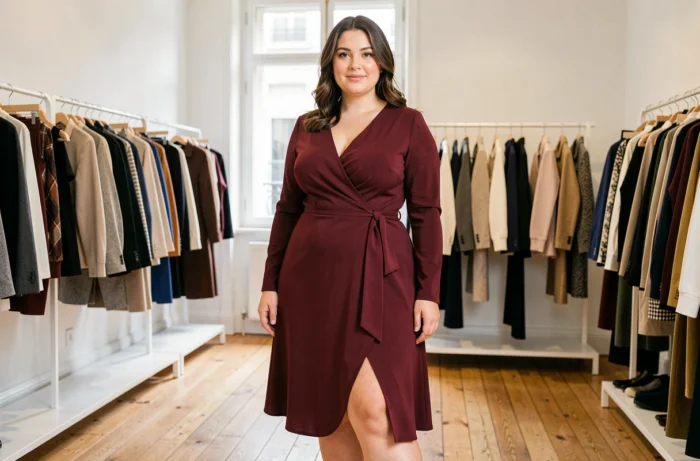
A bust whose volume concentrates in the lower part of the breast, with a thinner top and a naturally downward curve: this is what characterizes a pear-shaped bust. This very common morphology raises practical questions when choosing a top, a dress, or a bra.
Rather than listing generalities about female body types, this article focuses on the mechanisms that determine whether a garment works (or not) with this bust shape.
The role of the center gore and underwire in choosing a suitable bra
Before discussing visible clothing, we need to address the foundation: the bra. A poorly chosen model alters the entire silhouette and makes any top less flattering.
For a pear-shaped bust, the classic pitfall is a too-soft cup or a minimizer style. These bras flatten the lower part of the breast instead of repositioning it. The result: a flattened bust that draws the eye downward.
Have you ever noticed that a bra seems fine in front of the mirror but slips or rides up as soon as you move? Recent fitting guides emphasize a often-overlooked point: the movement support test. Raise your arms, bend forward, take a few steps. If the center gore (the rigid piece between the two cups) lifts off your sternum during these movements, the cut is not suitable.
A center gore that does not lay flat, or an underwire that rests on the breast tissue instead of properly encircling it, indicates a poor fit. For a pear-shaped bust, balconette or demi-cup styles with slightly structured cups offer a good compromise: they lift the volume without flattening it.
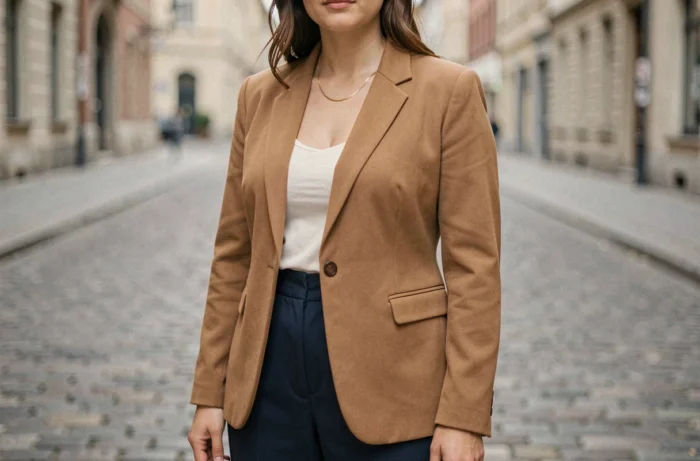
Necklines and cuts of tops that balance the silhouette
The principle is simple: when the volume of the bust pulls downward, the top garment must create a visual line that lifts or broadens the area above the bust.
Necklines that work
The V-neck is the most cited, and for good reason. It elongates the torso by creating a vertical line that starts from the neck. On a pear-shaped bust, it draws the eye upward toward the top of the neckline rather than the most voluminous area.
The boat neck produces a complementary effect: it visually broadens the shoulders. If your shoulders are narrow compared to your hips (which often accompanies this morphology), this neckline balances the upper/lower body proportions.
Square necklines and wrap tops work on the same principle. The wrap top, in particular, creates a crossed drape that hugs the top of the bust without flattening the lower part.
Necklines to avoid
The turtleneck and high neck are problematic. They eliminate any vertical line and bring the visual volume in a block, without distinction between the upper and lower parts of the bust. The result is a bust that appears heavier.
Very closed round neck tops produce a similar effect, especially in a thick fabric.
Fabrics and cuts for pear-shaped busts
The choice of fabric is as important as the cut. The same dress pattern can create two totally different silhouettes depending on the material.
- Medium-weight fabrics (crepe, poplin, structured cotton) maintain a shape around the bust without compressing it. They avoid the “flattened” effect of too-thin jerseys.
- Fluid and lightweight materials (chiffon, fine viscose) work well in layering, for example over a fitted camisole, as they add movement without adding volume.
- Very rigid fabrics (thick denim, waxed canvas) create unsightly folds at the lower bust. They do not adapt to the natural curve of the pear-shaped breast.
In terms of cut, empire waist dresses and tops deserve special mention. The seam placed just under the bust creates a clear separation between the bust and the rest of the body. This high line visually repositions the volume of the bust toward the center of the torso.
Péplum tops create a similar effect: the flared fabric under the bust diverts attention from the lower part of the breast to the waist.

Dresses and complete outfits: creating coherence between the upper and lower body
Enhancing a pear-shaped bust is not limited to the upper body. Visual balance also depends on what happens below.
Why is this choice so crucial? Because the pear shape of the bust often (but not always) accompanies an overall A silhouette, with hips wider than the shoulders. If this is your case, pairing slim pants with a loose top creates an imbalance: the top floats, the bottom compresses.
A straight or slightly flared bottom paired with a structured top produces a more harmonious silhouette. Palazzo pants, for example, balance the volumes by adding fullness at the bottom while the top structures the bust.
For dresses, the wrap model remains a safe bet. It combines three advantages in one garment: a V-neck that elongates, a crossover that supports the bust, and a skirt that can be fluid or straight depending on the desired silhouette.
Pieces to try in the fitting room
- Wrap dress in crepe: check that the crossover does not gape at the lower bust.
- Wrap top with a camisole underneath: the camisole provides support while the wrap top drapes.
- Fitted shirt slightly open: opening one or two buttons creates a natural V that replicates the effect of a structured neckline.
The most useful reflex in the fitting room remains to move. Just like with the bra, a garment that looks flattering from the front but pulls or rides up as soon as you raise your arms will not hold up throughout the day. Testing the fit in motion avoids disappointments once you’re home.
The pear-shaped bust benefits from being dressed in pieces that create volume or structure above the widest point of the breast. The neckline, the fabric, and the waistline do most of the work. The rest is a matter of trying on and personal comfort.