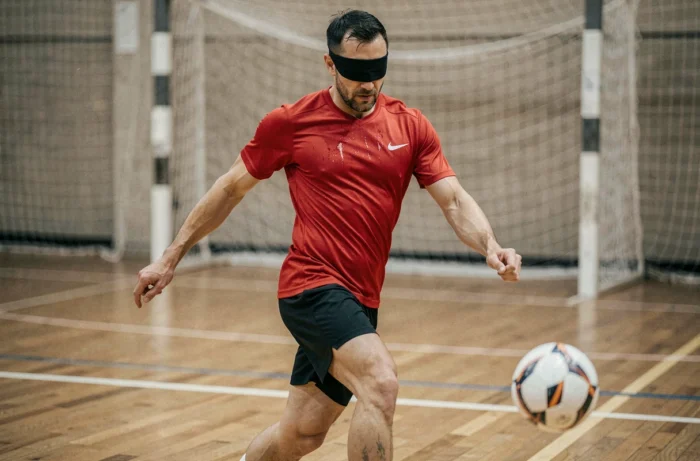
Blind football is based on an absolute sensory constraint: four field players wear blindfolds, regardless of their visual residue. This rule of equalization raises a recurring question in the para-sport community: can a sighted player participate, and under what conditions?
IBSA Classification and Regulatory Eligibility for Blind Football
The official competition leaves no room for interpretation. To compete in the B1 category (the one for the Paralympic Games and continental championships), a field player must hold an IBSA classification certifying a visual impairment. The classification process involves a standardized ophthalmological examination that measures residual visual acuity and field.
The blindfold, worn by all field players, is not meant to simulate blindness: it equalizes conditions among athletes whose visual residue varies. A player classified as B1 may have residual light perception, while another perceives nothing. The blindfold neutralizes this gap.
In the B2/B3 category, intended for visually impaired players, the visual acuity of the better eye after correction must not exceed a threshold defined by the national federation. It is therefore technically impossible for a sighted person to register for official competition, whether in B1 or B2/B3, without medical certification of visual impairment. The question of playing blind football without being blind then arises exclusively outside the framework of federal competitive play.
The only position open to sighted players in official matches remains that of goalkeeper, who does not wear a mask and vocally guides their defense from the goal area.
Mixed Sighted-Visually Impaired Sessions: A Structured Framework
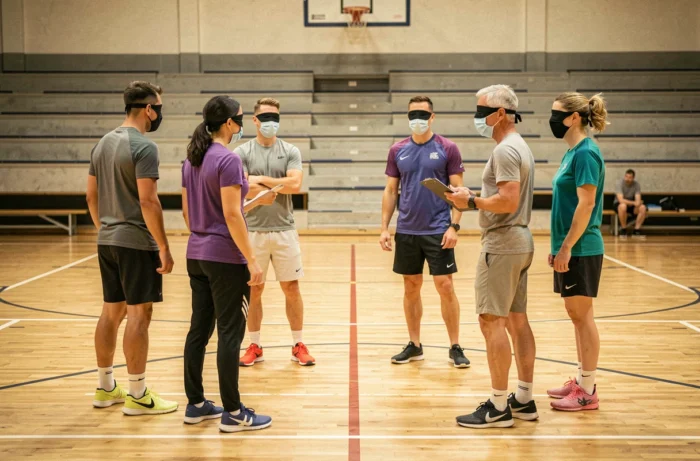
The most notable development in recent years concerns initiation programs open to all. In the UK, “whole class blind football activities” integrate entire classes, mostly composed of sighted students, around sound balls and blindfolds. The goal is not competitive: it is to create an inclusive environment where the visually impaired student is no longer the one who adapts, but the one who masters the codes of the game.
In France, several clubs affiliated with the Fédération Française Handisport offer discovery sessions. The format is simple: sighted participants wear blindfolds and play under the same conditions as visually impaired players. These sessions attract a varied audience, from amateur footballers curious to test their bearings without sight, to sports educators in training, and companies conducting seminars on disability.
What strikes sighted individuals during their first session is the total dependence on sound information. The ball contains jingles, the guide placed behind the opposing goal gives positional indications, and each defender must shout “voy” as they approach the ball carrier. Without these auditory cues, the game collapses.
What Sighted Players Discover When Playing Blindfolded
The experience is not just about raising awareness. It reveals transferable skills that traditional football underutilizes. Proprioception, stress management without visual cues, constant communication with teammates: these are areas of focus that some physical trainers are beginning to integrate into their protocols.
- Sound spatialization becomes the primary decision-making tool: locating the ball, estimating the distance to an opponent, identifying the guide’s voice behind the goal
- The touch on the ball changes radically, as the blindfolded player keeps the ball much closer to their feet to maintain contact
- The silence of the audience, mandatory during competitive play phases, takes on its full meaning: the slightest background noise disrupts the reading of the game
Euro Blind Football 2026: The Showcase That Changes Perception
The French blind football team retained its title at Euro 2026 held in Strasbourg, defeating England in the final. Frédéric Villeroux, nicknamed the “Zizou of blind football,” scored four goals during the tournament, including one goal described as “Maradona-esque” by the sports press.
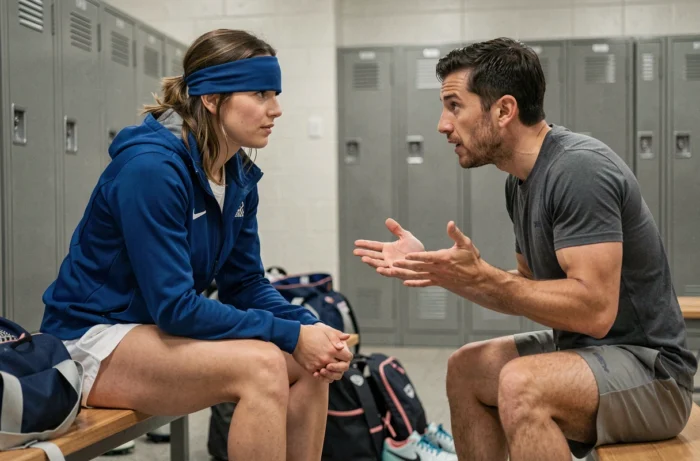
These media-covered performances change the game for the discipline. Blind football is stepping out of the para-sport circle to reach a general football audience. The atmosphere in Strasbourg was described as “crazy,” with spectators discovering for the first time the constraints of the game: the imposed silence during play, and the bursts of noise allowed only on goals.
This increased visibility generates a surge of requests for initiation in clubs. We observe that the majority of new registrants in discovery sessions are sighted individuals who have watched a blind football match and want to understand how players manage to dribble, shoot, and pass without any visual cues.
Practical Conditions for a Sighted Person Who Wants to Try Blind Football
Finding an initiation slot starts with clubs affiliated with the federation. The Cécifoot France website lists active structures in the territory. Some clubs integrate sighted individuals into their regular training, while others organize occasional events.
- No specific equipment is required for the participant: the club provides blindfolds, eye patches, and sound balls
- Sessions generally last less than a traditional training session, as the cognitive fatigue related to visual deprivation is considerable
- The regulation field measures 40 x 20 meters with side barriers, but initiations often take place in smaller spaces
- The role of guide (placed behind the opposing goal) can be assigned to an experienced sighted person, which constitutes another way to participate without playing blindfolded
The distinction remains clear between free practice and competition. A sighted person can train, discover, and progress in the discipline, but cannot compete in the federal championship without a classification of visual impairment. This boundary protects the sporting integrity of blind football while keeping the door open for an inclusive practice that benefits both sighted individuals and visually impaired players.