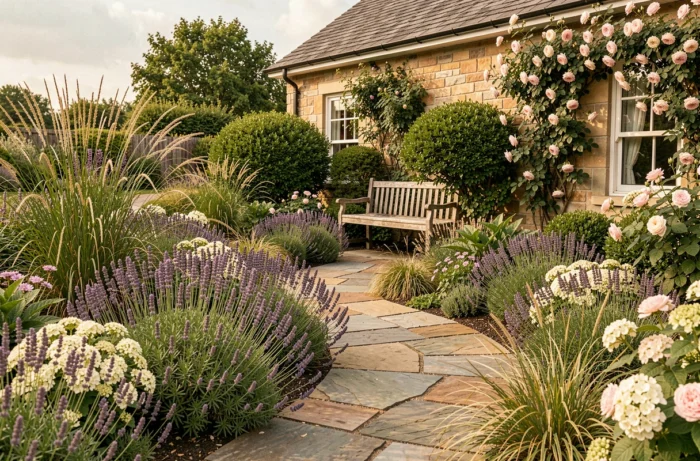
A gently sloping plot, clay soil that retains water after each downpour, a tired hedge of thuja at the property line: one rarely starts with a blank slate when planning a landscaped garden. The outcome depends less on a catalog of ideas than on correctly interpreting the constraints of the land. Understanding what already grows, identifying shaded areas in summer and pockets of moisture in winter is the foundation of a sustainable design.
Assessing the land before planting anything
Before choosing any plants, it’s beneficial to observe the land for a full day. Sunlight changes dramatically between morning and late afternoon, and an area that seems ideal in March can become sweltering in July.
The soil dictates everything else. Sandy, well-draining soil is managed very differently from compact clay soil. Testing the soil texture by hand (forming a ball of moist soil, observing whether it cracks or remains sticky) already provides a reliable indication of natural drainage and necessary amendments.
It’s also important to note natural pathways: where do we spontaneously walk to get to the garage, the compost, the clothesline? These daily routes should become paths, not trampled lawns. A landscaping plan that ignores the actual uses of the garden always ends up being circumvented.
Specialized resources like jardinsetpayssages.com allow you to visualize projects suited to different types of land and configurations, helping to calibrate expectations before diving in.
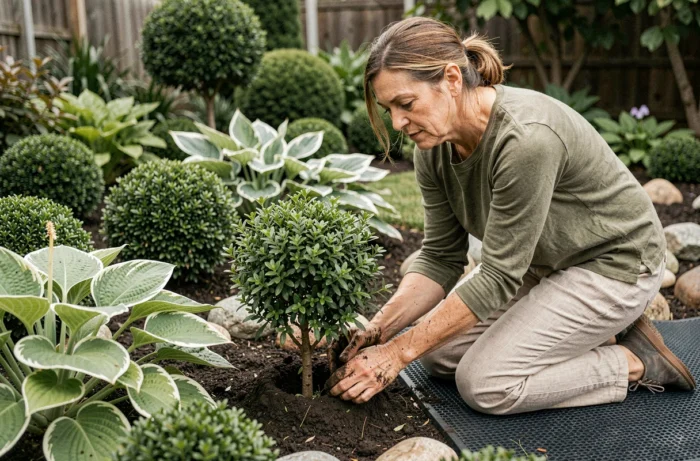
Watering restrictions and sustainable landscape design
Competitors talk a lot about styles and materials but overlook a crucial parameter: water regulations. During drought periods, prefects implement a system of four levels of restrictions, from vigilance to crisis. As soon as the alert level is reached, watering lawns and flower beds is often prohibited during hot hours. At the crisis level, the ban can become total.
Designing a landscaped garden without incorporating this constraint risks seeing your plants wilt every summer. Therefore, we prioritize water-efficient plants for south-facing beds: lavenders, sages, ornamental grasses, yarrow.
Organizing areas according to their water needs
The principle of hydric zoning involves grouping water-hungry plants (hydrangeas, hostas) in the naturally cool parts of the garden, in the shade of a wall or at the bottom of a slope. Mediterranean species or rock garden plants occupy dry, sunny areas.
- Wet zone (bottom of slope, near a water source): ferns, astilbes, marsh irises, which benefit from natural drainage without additional watering
- Intermediate zone (partial shade, cool soil): classic perennials like hardy geraniums, heucheras, or brunneras
- Dry zone (full sun, well-draining soil): gaura, euphorbias, rosemary, blue fescue, which can withstand several weeks without rain
This division reduces water consumption and creates varied atmospheres throughout the garden, enhancing the sense of harmony.
Structuring space with volumes, not just flowers
A landscaped garden that relies solely on flower beds loses all depth in winter. Structure comes from trees, evergreen shrubs, trimmed or natural hedges, and built elements like a low wall, a pergola, or a simple Japanese stepping stone path.
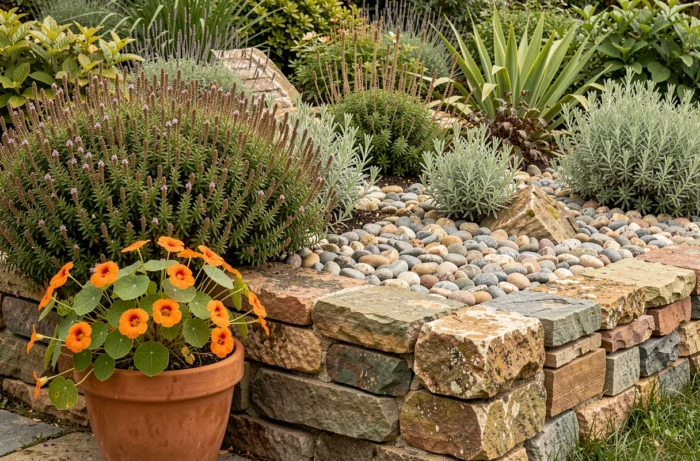
We think in layers. The upper layer (trees) sets the scale of the garden. The middle layer (large shrubs, climbing plants on supports) creates screens and transitions. The lower layer (ground covers, perennials, grasses) dresses the ground and connects the different areas.
Creating perspectives even in a small garden
In a small space, the classic mistake is to push everything against the fences. This results in an empty rectangle in the middle, lacking depth. Shifting a flower bed or a small tree to a third of the plot breaks symmetry and visually extends the perspective.
A slightly curved path that disappears behind a shrub gives the illusion that the garden continues beyond. This type of design works even on a modestly sized plot, provided that the materials on the ground are not multiplied (one type of gravel or paving is sufficient).
Micro-basins and water features in a family garden
Water adds a sensory dimension that no plant can replicate alone. Micro-basins, even of small volume, promote local biodiversity: pollinating insects, dragonflies, small wildlife. They also break the “all-mineral” look that dominates many current terraces and courtyards.
A dug pond with an EPDM liner, a few bank plants (reeds, water mint, marsh forget-me-nots), and a small solar pump is enough to create a calming focal point without heavy construction. The sound of flowing water immediately changes the atmosphere of a garden corner.
- Plan for a semi-shaded location to limit algae growth in summer
- Install a shallow area on one edge to allow birds and hedgehogs to drink safely
- Avoid placing the pond under a deciduous tree unless a net is planned for autumn
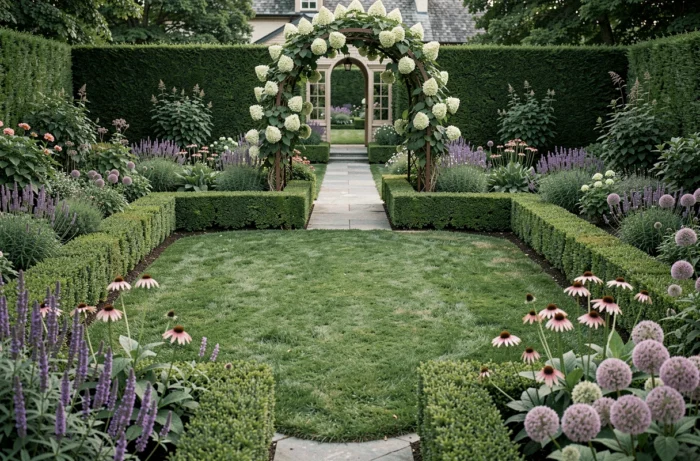
Regulations to check before digging
Diverting a stream or capturing a spring to supply a water feature in your garden is not legally trivial. Regulations vary by municipality, but in most cases, prior declaration or authorization is required as soon as you touch a watercourse, even a minor one. A micro-basin fed by rainwater, on the other hand, generally poses no problem.
A harmonious landscaped garden is not just a beautiful assembly of plants. It rests on three concrete pillars: an honest reading of the land, a zoning adapted to actual water constraints, and volumes that structure the space in all seasons. Flowers come later, to dress a framework that already functions without them.