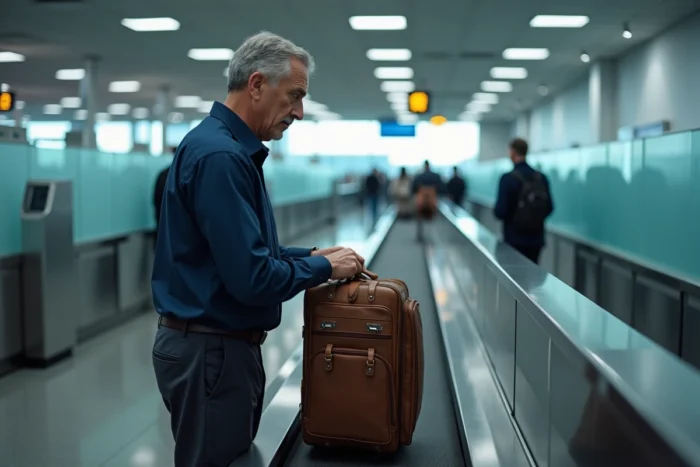
A traveler carrying a thick envelope of cash in their carry-on rarely questions this before arriving at the security checkpoint. The answer is two words: scanners detect the density of objects, not their financial nature. Banknotes appear on the screen like any block of paper, and it is the agent’s reaction, not the machine, that triggers a check.
What the agent actually sees behind the scanner screen
The X-ray machines used at airport security checkpoints operate by differentiating density and chemical composition. Organic materials (paper, textiles, food) show up in orange. Metals appear in blue or green. A compact bundle of cash thus resembles a paperback book or a pack of tissues.
In practice, one can slip a few hundred euros into a wallet without anyone raising an eyebrow. A larger amount, stored in a plastic bag or a thick envelope, may attract attention due to its dense rectangular shape. The agent then asks to open the bag for a visual check.
A often overlooked point: the question of airport scanners and banknote detection only concerns air security. Security agents are looking for dangerous objects, not money. Their mission is not customs-related. The confusion between security checks and customs checks is the source of most misunderstandings.

Security checks and customs checks: two distinct systems at the airport
At the scanner, security agents have no authority to seize or question a passenger about their cash. Their scope is limited to prohibited items in the cabin. Carrying a large sum does not constitute an infringement of air security.
Customs checks, on the other hand, occur at a different time and place. In France, customs officers are stationed at entry and exit points of the territory, often after the baggage claim area or before boarding flights outside the European Union. They are the ones who check cash declarations.
What the concept of cash covers according to customs
The regulation (EU) 2018/1672 has expanded the definition well beyond simple banknotes and coins. Customs can check:
- Banknotes and coins in circulation, including foreign currencies
- Negotiable instruments to bearer (traveler’s checks, money orders, non-resident promissory notes)
- Gold in the form of bars, coins, or nuggets, as well as loaded prepaid cards
It is often thought that simply distributing banknotes across several pockets will go unnoticed. Customs officers proceed by sampling and behavioral profiling. A manual search quickly reveals scattered bundles.
Declaration threshold and customs penalties in France
Anyone carrying 10,000 euros or more in cash (or the equivalent in foreign currency) must declare it to customs when entering or leaving the European Union. This threshold applies per person, not per family or group.
The declaration is made via the cerfa form available online or at the airport customs desk. In practice, it can be filled out before departure to save time. Some third countries are starting to offer electronic declaration systems, such as the ALCES system in Algeria, which allows travelers to declare their currency online before the trip.
What are the actual risks in case of forgetfulness or fraud
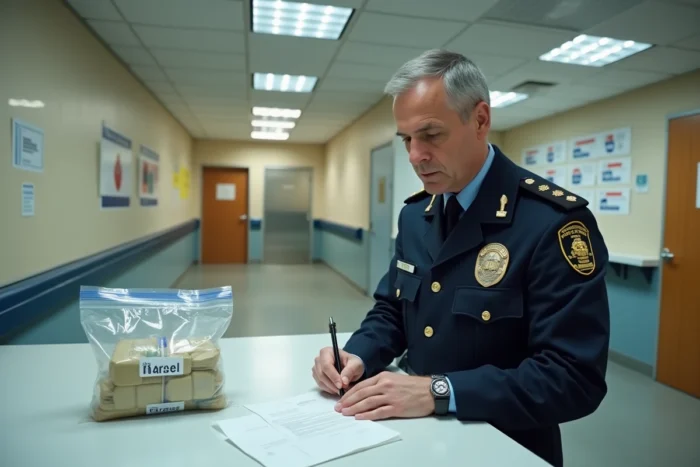
Failing to declare an amount equal to or exceeding the threshold exposes one to heavy penalties. Customs can seize the entire amount transported, not just the excess portion. A proportional fine is added to the seizure, and the case may lead to prosecution for money laundering if customs officers suspect an illicit origin of the funds.
The French system has been strengthened with the overhaul of the customs code, which now incorporates the provisions of European regulation 2018/1672. Responses vary on intra-EU checks, but random inspections exist on flights between member states, particularly on certain sensitive routes.
Transporting banknotes in the cabin or in the hold: which option to choose
Placing cash in the hold is legal but risky. Hold luggage is handled by many people, and loss or theft of cash in the hold is almost never compensated by the airline. The general conditions almost systematically exclude cash from covered valuables.
In the cabin, one maintains physical control over the amount. Passing through the scanner is not a problem in itself. It is enough to store it in a bag or wallet, without trying to hide it. Hiding (banknotes taped to the body, concealed in soles) has no interest in terms of security, but it raises suspicions among customs officers in case of random checks.
Practical reflexes before boarding
- Keep proof of the origin of the funds (bank statement, withdrawal certificate) in case of customs questioning
- Fill out the customs declaration as soon as the amount reaches the threshold, even if traveling within the EU as a precaution
- Never distribute money among several passengers to circumvent the threshold: this practice is known to customs officers and considered “smurfing,” an indicator of fraud
- Prefer a flat pouch in the cabin rather than a bulky envelope that attracts attention at the scanner
The initial question of whether one can transport banknotes without being detected is based on a misunderstanding. The security scanner does not “detect” money as it would detect a knife. It is customs control, not the scanner, that constitutes the real filter. Properly declaring a large amount remains the only legal and reliable method to travel with cash without risking the seizure of all one’s funds.