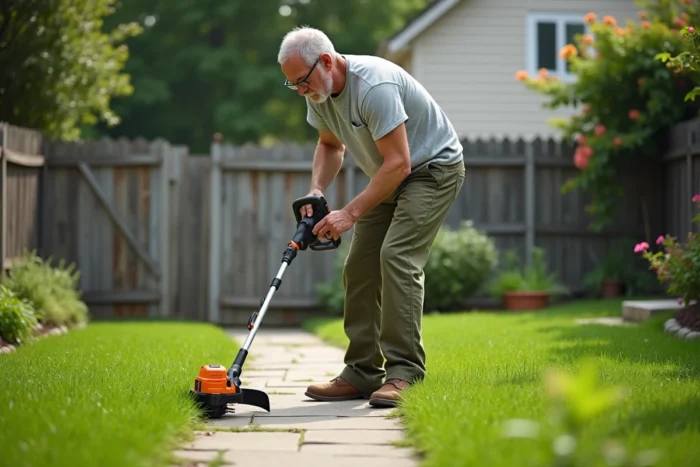
On a battery-powered trimmer, the nominal power displayed on the product sheet rarely reflects the actual cutting capacity under usage conditions. The voltage, battery capacity, motor torque, and overall weight form a system where each parameter limits or amplifies the others. Choosing the right power for a battery-powered trimmer requires reasoning in terms of usable power, not peak watts.
Usable power of a battery-powered trimmer: what voltage doesn’t tell you
A trimmer rated at 36 V does not deliver twice the power of an 18 V model. The nominal voltage indicates the energy potential of the pack, not the torque actually transmitted to the cutting head. Two machines with the same voltage can offer very different performances depending on the quality of the motor (brushless or brushed), the cutting diameter, and the management electronics.
To delve deeper into the sizing criteria, consult this guide on what power to choose for a battery-powered trimmer. We regularly observe that motor torque matters more than raw voltage for maintaining the rotation speed of the line in resistant vegetation. A brushless motor maintains a stable speed when the load increases, whereas a brushed motor loses efficiency as the grass thickens.
The battery capacity (expressed in Ah) determines how long this power remains available. A low-capacity pack on a power-hungry motor will force the electronics to reduce the speed to protect the cells, which decreases cutting power well before complete shutdown. The actual power drops before the battery is empty.
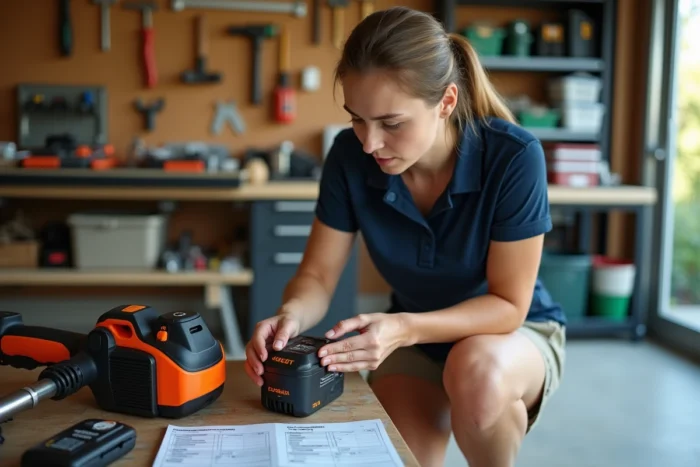
Battery capacity and weight in hand: the real technical trade-off
Increasing battery capacity (switching from a standard pack to a higher-capacity pack, like 4 Ah) extends runtime and stabilizes the delivered power. However, the extra weight of the pack directly impacts user fatigue and the machine’s maneuverability.
A battery-powered trimmer is held at arm’s length, often in an inclined position. Every extra gram on the head or handle changes the balance and accelerates muscle fatigue in the wrist and forearm. Beyond a certain duration of continuous use, the loss of precision in the cutting action negates the power gain.
Finding the balance between runtime and maneuverability
We recommend reasoning in terms of “usable power for 20 minutes of dense grass” rather than maximum advertised runtime. The manufacturer’s runtime is measured under light load (short grass, spaced passes). In real conditions, with slightly taller vegetation and a sustained pace, the effective runtime often drops to half the advertised value.
- A standard capacity pack is suitable for regular finishing on maintained edges, with short sessions
- A higher-capacity pack becomes relevant as soon as the terrain has dense areas or the edge surface exceeds a few dozen linear meters
- On modular ranges (interchangeable battery between tools), having two packs allows for a complete session without compromising on unit weight
Line rotation speed and cutting diameter: the overlooked parameters
The rotation speed of the cutting head determines the effectiveness of the nylon line as much as the motor power. A line that spins too slowly tears the grass instead of cutting it, regardless of the machine’s voltage. A clean cut depends on the peripheral speed of the line, not just on motor power.
The cutting diameter (the width of the swath cut in one pass) also plays a role. A larger diameter covers more area per pass, which reduces usage time and thus battery demand. Conversely, a larger cutting diameter requires more torque to maintain the line’s speed over the entire exposed length.
Nylon line or plastic blades: impact on the required power
Rotating plastic blade heads require less power than nylon line for a comparable result in fine grass. In tougher vegetation, thick nylon line remains more effective, but it demands more from the motor and battery.
Thus, the choice of cutting head conditions the minimum power threshold. A modest motor paired with plastic blades may suffice for regular maintenance, while versatile use (tall grasses, tough grasses, flowerbed edges) requires a motor capable of maintaining a nylon line at high speed under load.

Modular ranges and interchangeable batteries: an underestimated selection criterion
Interchangeable battery systems (the same battery compatible with multiple garden tools) change the economic and practical equation of power selection. Investing in a more powerful pack is justified when it also powers the lawnmower, blower, or hedge trimmer.
This point has a direct consequence on the choice of trimmer: the battery platform often dictates the available voltage and capacity. If your tool set operates on a given platform, the trimmer must fit into it, which sometimes limits power options.
- Check the battery compatibility with other tools in the set before choosing a model
- Prefer a platform that offers packs of varying capacities to adapt runtime to the type of task
- A higher-capacity pack purchased for a power-hungry tool (lawnmower, blower) also benefits the trimmer without additional cost
The power selection of a battery-powered trimmer is not just about comparing voltage figures. It is the match between motor torque, pack capacity, total weight in hand, and the actual nature of the terrain that determines whether the machine remains effective after the first few minutes. A model well-sized for your specific use will always be better than an overpowered device on paper that is too heavy to hold comfortably over time.