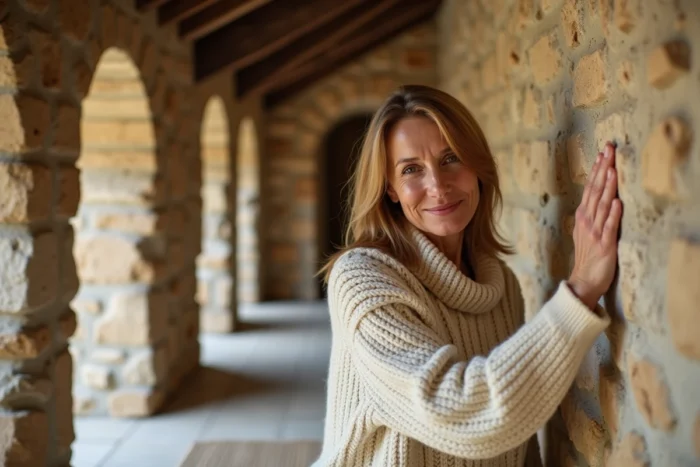
Stone stores heat slowly and releases it with a delay of several hours. This property, called thermal inertia, is often confused with insulation capacity. In reality, a stone wall made of cut stone or rubble allows cold to pass through much faster than a wall insulated from the inside or outside. Understanding this distinction is the starting point for improving the thermal comfort of a stone house without degrading the building.
Thermal inertia and conductivity: two concepts not to be confused
Thermal inertia refers to a material’s ability to accumulate heat and then release it gradually. A thick stone wall absorbs heat from the sun or heating during the day and then diffuses it at night. This phenomenon naturally regulates indoor temperature fluctuations.
Thermal conductivity, on the other hand, measures how quickly heat passes through a material. Stone, whether limestone, granite, or sandstone, conducts heat quite well. An uninsulated wall of this type acts as a bridge between the heated interior and the cold exterior.
Confusing these two quantities leads to a common mistake: believing that a thick wall is enough to keep heat in a stone house without additional intervention. Thickness slows down the transfer but does not prevent it. Without additional insulation, the walls remain cold to the touch, which creates discomfort even when the ambient air reaches a comfortable temperature.
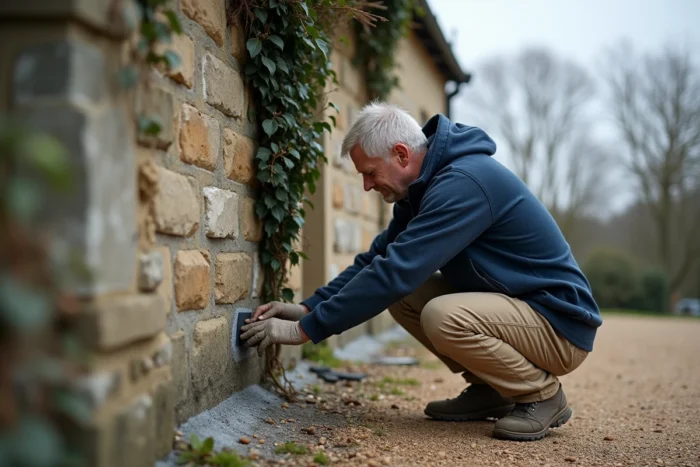
Insulating stone walls: interior, exterior, or corrective coating
The choice of insulation technique depends on the moisture condition of the wall and its ability to expel water vapor. An old stone wall breathes: it absorbs ambient moisture and releases it to the outside. Blocking this cycle with a waterproof insulation causes internal condensation, mold, and then accelerated degradation of the joints and mortar.
Interior insulation with a breathable insulation
Insulations made from wood fibers, hemp, or cork allow water vapor to pass while slowing down heat transfer. Installed against the wall with a technical void or an appropriate base coat, they maintain the breathing mechanism of the old building.
This solution preserves the exterior appearance of the stone façade, which is important for buildings located in protected areas or town centers. The trade-off is a slight loss of living space.
Exterior insulation under coating or cladding
External thermal insulation (ITE) eliminates thermal bridges at the level of floors and partitions. It wraps the building in a continuous layer of insulation, covered with a coating or ventilated cladding. The stone wall then retains its role as thermal mass inside, improving comfort in both summer and winter.
ITE alters the appearance of the façade. In some cases, the architects of historic buildings refuse this option. Checking local urban planning rules before any project avoids costly setbacks.
Thermal corrective coating
For walls where classic insulation is impossible (listed façade, insufficient thickness), a lime-hemp coating applied in a thick layer provides a modest but real thermal gain. This type of coating also regulates humidity, reducing the feeling of cold associated with damp walls.
Windows, attics, and floors: priority thermal leaks
Walls are not the only culprits of heat loss. In an old stone house, single-glazed windows, poorly insulated roofs, and low floors on a concrete slab often account for the majority of losses.
- Attics and roofs represent the most significant loss area in most individual houses. Insulating the slopes or the floor of the lost attic with bulk insulation (cellulose wadding, wood wool) offers a high cost-effectiveness ratio.
- Replacing single-glazed windows with double glazing with enhanced insulation significantly reduces losses at openings. For old joinery in good condition, installing secondary glazing or a peripheral sealing joint is a less expensive alternative.
- The low floor, especially when it rests on a crawl space or cellar, allows cold to rise from the ground. Underfloor insulation (rigid panels fixed under the floor) corrects this flaw without changing the level of the interior floor.
Regulations and financial aid for stone houses classified F or G
Since 2025, energy audits are mandatory for the sale of individual houses classified E, F, or G in the energy performance diagnosis (DPE). Many old stone houses fall into these categories, forcing owners to undertake work to maintain the value of their property or continue renting it.
The developments of MaPrimeRénov’ strongly direct aid towards comprehensive work packages. Isolating by isolated gesture (walls only or floors only) should gradually be phased out in favor of overall renovations. For an owner who simply wants to improve the thermal comfort of their stone house, this means it becomes more cost-effective to combine wall insulation, window replacement, and roof treatment in the same project.
This logic of comprehensive renovation aligns well with the specificities of stone buildings. Addressing a single issue without considering others shifts the problem: insulating walls without proper ventilation encourages condensation, replacing windows without treating walls amplifies the sensation of cold walls.
Ventilation and moisture management in stone walls
An old stone wall functions as a hygrometric regulator. If the indoor air is not renewed, moisture accumulates in the masonry and degrades both the insulation and thermal comfort. A damp wall conducts heat much faster than a dry wall, which negates some of the gains made by insulation.
Installing a hygro-regulated mechanical ventilation system (VMC) adjusts the extraction rate to the actual humidity level in each room. In old houses without technical ducts, a simple flow VMC through extraction, coupled with air inlets on the joinery, represents the simplest solution to implement.
Before insulating, having a professional check the moisture condition of the wall can help identify any rising damp. A prior treatment (peripheral drainage, injection of hydrophobic resin at the bottom of the wall) conditions the durability of any insulation applied afterward.
Retaining heat in a stone house requires coordinated work on the envelope, ventilation, and water management. Each isolated intervention provides a partial gain, but it is their combination that truly transforms daily comfort, winter after winter.