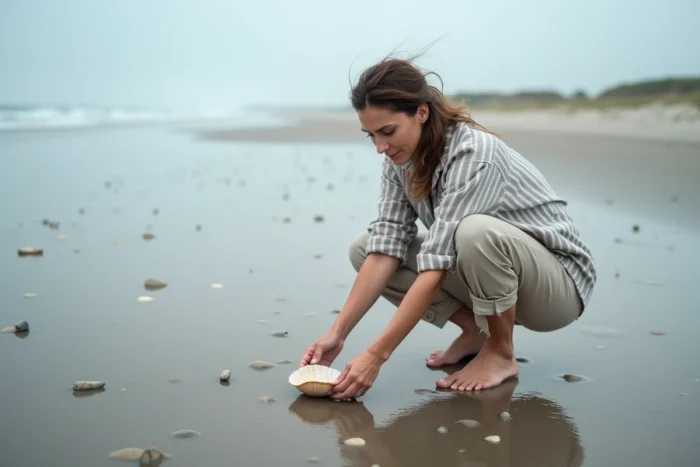
Collecting shells in the Landes is not just about choosing a beach at random. Between the prefectural orders that temporarily close certain sites, the tide coefficients that determine access to the foreshore, and the species present depending on the areas, each outing requires a minimum of preparation. This article compares the main spots along the Landes coast based on concrete criteria: accessibility, type of seabed, collectible species, and regulatory constraints to check before heading out.
Comparison of Shellfish Spots on the Landes Coast
The Landes department features a nearly straight coastline, dominated by sand. Rocky areas are rare, which concentrates shellfish gathering on specific sectors where the seabed configuration (shellfish banks, muddy areas, estuaries) allows species to settle.
| Spot | Type of Seabed | Common Species | Access at Low Tide | Main Constraint |
|---|---|---|---|---|
| Capbreton (south beach and Boucarot) | Fine sand, rocky areas near the gouf | Clams, cockles, razor clams | Good from coefficient 80+ | Frequent municipal orders in summer |
| Hossegor (lake and central beach) | Sand, shellfish banks on the lake side | Clams, surf clams | Variable depending on sand accumulation | Monitored swimming area in season |
| Biscarrosse (north beach) | Wet sand, wide foreshore | Clams, knives | Very good during spring tides | Distance from parking |
| Vieux-Boucau (lake beach) | Sand and mud at the lake’s edge | Surf clams, cockles | Average (narrower foreshore) | Shallow lake depth, limited access |
| Moliets-et-Maa (Huchet stream) | Sand, estuary | Razor clams, cockles | Depends on current flow | Protected natural area nearby |
This table highlights a often overlooked point: the majority of Landes beaches are pure sand, which limits species diversity compared to rocky foreshore areas in Brittany or Charente. The most productive spots are where a geological or hydrological peculiarity breaks this uniformity.
To know exactly where to find shellfish in the Landes, one must cross-reference the nature of the seabed with the tide coefficients of the day and the absence of ongoing health prohibitions.
Health Orders and Temporary Bans in the Landes
This is the factor that most spot guides overlook, and it is the one that makes an outing pointless if not checked. For several seasons, the prefectures along the Atlantic coast have been increasing temporary bans on shellfish gathering in summer, related to bacterial contamination or toxic phytoplankton blooms.
Between June 1 and September 15, additional municipal orders may be issued following poor water quality results. These closures are not systematically reported in tourist guides or on beach signs.
How to Check Before You Go
- Consult the health atlas of shellfish farming areas updated by state services, which lists the prohibitions in effect zone by zone
- Check the orders published on the Landes prefecture’s website, especially after an episode of heavy rain or heat
- Inquire at the town hall of the targeted spot on the morning of the outing, as a ban can be triggered overnight
A spot like Capbreton, regularly cited among the best in the department, can find itself closed to shellfish gathering for several weeks in a row during the height of summer. Planning an outing without this verification amounts to taking a real health risk.
Tide Coefficients and Gathering Windows on the Landes Coast
On such a linear and sandy coastline, the tide coefficient determines the available foreshore area. With a coefficient below 70, the exposed sand strip remains too narrow to access the shellfish banks. Productive outings really begin from a coefficient of 80, and spring tides (above 100) open up areas that are usually submerged where clams and cockles are more abundant.
The site mareefrance.com allows you to check the times and coefficients for each port along the Landes coast, from Biscarrosse to Capbreton. The useful gathering window is between two hours before and one hour after low tide.
Difference Between Beaches and Lacustrine Areas
Hossegor presents a particular case with its marine lake, connected to the ocean by a canal. Tides enter there with a delay and reduced amplitude. The shellfish banks of Hossegor lake remain accessible at lower coefficients than those of the ocean beach, making it an interesting option on days of low tidal range.
However, the species there are less varied: mainly clams and a few surf clams can be found, whereas the ocean beach of Capbreton, thanks to the proximity of the underwater gouf, attracts a more diverse range of species.
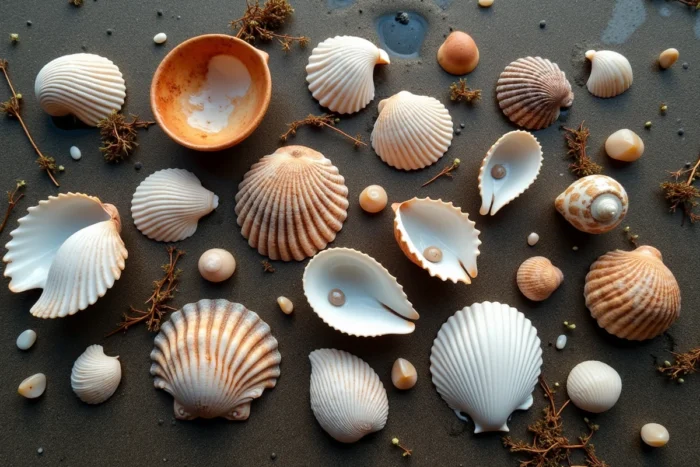
Collectible Shellfish Species in the Landes and Regulatory Sizes
The Landes coastline does not offer the same diversity as a Breton foreshore or the Arcachon basin. The species accessible for recreational shellfish gathering focus on a few families well adapted to sandy bottoms.
- Clams: the most common species on Landes beaches, buried in the first centimeters of wet sand. Minimum capture size regulated
- Palourdes: present in areas where sand mixes with mud, particularly around current estuaries (Huchet, Soustons)
- Razor clams: small bivalves very common on the ocean foreshore, often overlooked but edible
- Knives: identifiable by their characteristic holes in the sand, they require a specific technique (salt poured into the hole)
National regulations impose minimum capture sizes and maximum quantities per person per day for recreational shellfish gathering. These thresholds vary by species and can be reinforced locally by prefectural order.
The Landes coastline rewards those who prepare their outing. Checking health regulations, choosing an appropriate tide coefficient, and targeting the right type of seabed makes the difference between a walk with empty hands and a satisfactory harvest. The beaches of Capbreton and Biscarrosse remain the most consistent spots in the department, provided that no prohibition is in effect on the planned day.