
Between GelActiv insoles, Bioprint technologies, and laboratory-tested models against slipping, the Dr Scholl range for women is no longer limited to the wooden clogs of the 1970s. Measuring what these shoes concretely bring to the female foot requires comparing their technologies, uses, and limitations against the criteria used by podiatrists.
Dr Scholl Insole Technologies: What Each Range Targets
The Scholl brand segments its women’s models around several insole technologies, each designed to address a specific issue or need. These technologies are described as developed in collaboration with podiatrists.
| Technology | Target Area | Main Use |
|---|---|---|
| GelActiv | Shock absorption under the heel and forefoot | Extended walking on hard surfaces |
| Memory Cushion | Pressure distribution across the entire arch | Daily standing |
| Bioprint | Mapping of the foot arch | Mild postural correction |
| Biomechanics | Lateral support and pronation control | Over-pronation, flat feet |
This segmentation allows for choosing a model not based on its appearance, but on the foot problem to be addressed. A woman prone to heel spur is not looking for the same insole as a woman who stands for twelve hours in a hospital environment.
Among Dr Scholl shoes for women, some models combine two of these technologies, which complicates the reading of product sheets but broadens the comfort spectrum.
Slip Resistance: A Measurable Criterion that Distinguishes Dr Scholl
Perceived comfort dominates the communication of most wellness shoe brands. Dr Scholl stands out in a more verifiable area: slip resistance.
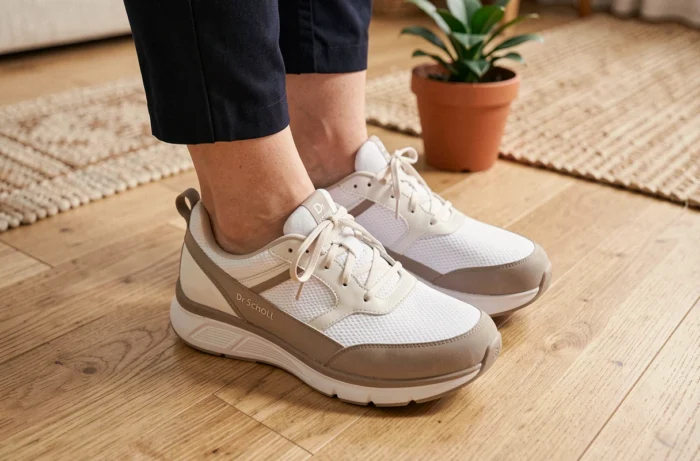
Some recent women’s models, such as the Time On Women’s Slip Resistant Work Shoes, have been tested in an independent laboratory. The measured comfort performance exceeds the industry average, and the Lock Step Outsole is designed to reduce the risk of slipping on wet or greasy surfaces.
This type of laboratory testing is still uncommon in the mainstream comfort shoe segment. Most competitors rely on generic mentions (“non-slip sole”) without documented measurement protocols. In contrast, Dr Scholl publishes results from standardized tests, providing consumers with an objective comparison criterion.
Why Slip Resistance Matters as Much as Cushioning
Foot pain does not all stem from cushioning or support. A slipping shoe alters walking posture: the foot constantly contracts its stabilizing muscles, which accelerates foot fatigue and can worsen conditions like plantar fasciitis.
For women who work on their feet (caregivers, teachers, salespeople), slip resistance is a factor in foot care just as much as arch support.
Dr Scholl vs. Custom Orthotic Insoles
One point that product sheets do not directly address: Dr Scholl shoes do not replace a custom orthotic insole prescribed by a podiatrist. They occupy an intermediate niche.
- Custom insoles correct a diagnosed imbalance (valgus, severe metatarsalgia, length inequality). Their cost is significantly higher, and they require a consultation.
- Dr Scholl technologies (GelActiv, Biomechanics) aim for preventive comfort and relief from moderate pain, without claiming to provide complete orthopedic correction.
- For mild issues like foot fatigue at the end of the day or slight over-pronation, Dr Scholl models offer an accessible solution without a medical appointment.
This distinction is useful to avoid disappointment: buying a Dr Scholl shoe in the hope of resolving a diagnosed heel spur will not yield the same results as podiatric care. The product provides relief; it does not treat in the medical sense.
Medical Heritage and Fashion Positioning: An Unstable Balance
The Scholl brand was founded by Dr. William Mathias Scholl, who patented the Foot-Eazer in 1904, a half-sole for arch support. He then established the Illinois College of Chiropody and Orthopaedics, which became a reference in the field. More than a century of expertise in foot biomechanics fuels the brand’s technical credibility.
However, the Pescura, a historical emblem with its wooden sole and leather strap, has undergone a marked fashion shift. In the 2000s, major brands (Céline, Chanel, Burberry) seized the model. This repositioning broadened the audience but blurred the health message.
What This Changes for Choosing a Pair
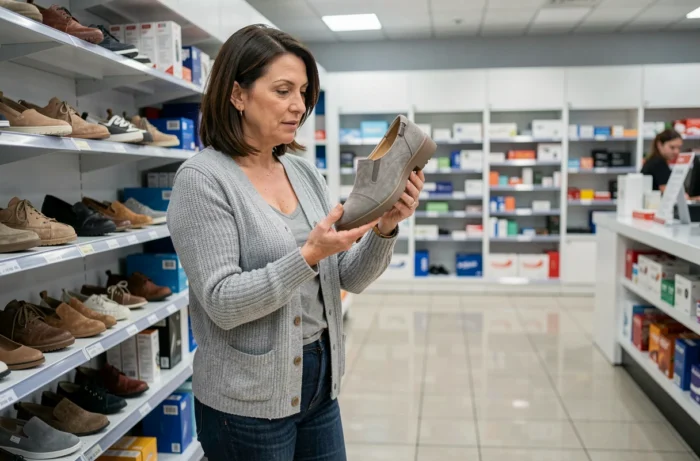
A model stamped Dr Scholl can be a fashion accessory without advanced insole technology or a professionally tested comfort product. Checking the integrated insole technology before purchase remains the only way to know if the pair meets a real wellness need.
The current women’s ranges cover both city sandals and slip-resistant work shoes. The name of the technology (GelActiv, Bioprint, Biomechanics) on the product sheet is the reliable indicator, not the exterior design.
Choosing a Dr Scholl shoe for women should be based on the insole technology and the targeted issue, not on appearance or brand notoriety. Consulting a podiatrist remains relevant for any persistent problem, with comfort shoes acting as a complement, not a substitute.