
On the ground, the classic situation looks like this: you measure a garden, a plot, or an oddly shaped room, you get four different lengths, and you find yourself stuck. The formula length x width only works for a rectangle. As soon as the four sides are not the same length and the angles are not right, you need to change your method.
Several approaches allow you to get by with a tape measure, a bit of method, and sometimes a phone app.
Why measuring four sides is not enough to calculate the area
It is often believed that with the four lengths of a plot, the calculation is settled. In reality, four sides do not define a unique shape. A quadrilateral with the same sides can be flattened, stretched, or twisted depending on its angles. Two plots with identical sides can have very different areas.
To eliminate this ambiguity, you need additional information: either an angle or a diagonal. Without this fifth measurement, no formula provides a reliable result. Recent online calculators emphasize this point and systematically ask you to confirm that you have a diagonal or an angle before starting the calculation.
When you want to calculate an area in m2 with 4 different sides, this verification step avoids the most common errors. If you skip the diagonal measurement, you will get at best a rough approximation.
Diagonal method and Heron’s formula for an irregular plot
The most reliable method on the ground involves dividing the quadrilateral into two triangles using a diagonal measured on the ground. You draw the easiest accessible diagonal (the one that does not pass through an obstacle like a tree or a wall), then measure its length.

You then obtain two triangles for which you know all three sides each. Heron’s formula allows you to calculate the area of each triangle without needing to measure an angle.
For a triangle with sides a, b, and c, you first calculate the semi-perimeter: s = (a + b + c) / 2. The area is then the square root of s(s-a)(s-b)(s-c). You repeat the operation for the second triangle and add the two results.
- Measure the four sides of the quadrilateral with a tape measure or laser rangefinder
- Draw and measure an interior diagonal, preferably the longest
- Apply Heron’s formula to each of the two triangles obtained
- Add the two areas to get the total area in m2
This method works for any quadrilateral, whether it is convex or concave. For a concave quadrilateral, use the diagonal that stays inside the shape, otherwise the result will be incorrect.
Concrete example on a garden plot
Let’s take a plot with four measured sides and a diagonal recorded on the ground. We identify the first triangle (side 1, side 2, diagonal) and the second (side 3, side 4, diagonal). We apply Heron twice. The total gives the area of the garden in square meters, ready to appear on a plan or an excavation estimate.
Calculation by diagonals and angle: an alternative when you have a protractor
When you know the two diagonals of a quadrilateral and the angle they form with each other, a direct formula gives the area: area = (d1 x d2 x sin(angle)) / 2. It’s quick and avoids going through Heron.
On a construction site, this method is useful when both diagonals are easy to measure (clear ground, empty room) and you have a tool to measure the angle, even approximately. Some smartphone measurement apps provide this angle from an aerial photo or a cadastral plan.
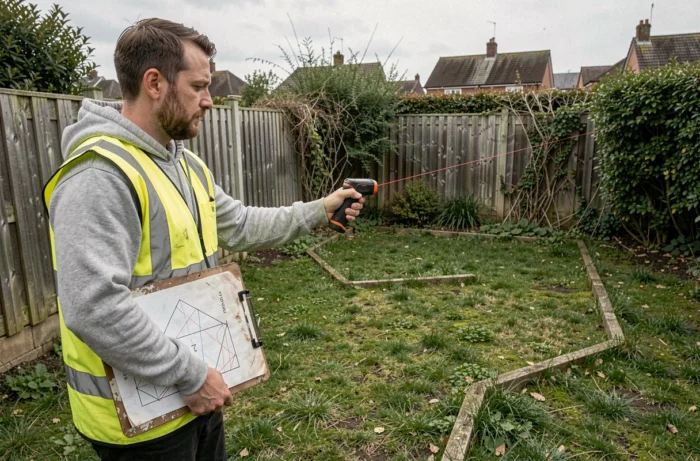
Feedback varies on the accuracy of this method compared to triangulation by Heron. In practice, if the angle is measured carefully, both approaches yield very similar results. The error almost always comes from a hasty ground measurement, not from the chosen formula.
Common errors and field checks
The first source of error is confusing a generic quadrilateral with a trapezoid or a parallelogram. If the opposite sides are not parallel, applying the trapezoid formula gives an incorrect result. Check the parallelism on the ground before choosing your formula.
The second trap: neglecting the slope. A surface measured on a slope appears larger than its horizontal projection on the ground. For a tiling estimate or a declaration of living area, it is the horizontal projection that counts.
- Check the parallelism of the opposite sides before choosing a simplified formula
- On a sloped plot, adjust the measurement to obtain the projected area
- Measure the diagonal by keeping the tape taut on the ground, without deviation
- Redo the calculation with the second diagonal if possible, to cross-check the result
A good reflex is to cross-check the result using two different methods. If triangulation by Heron and the diagonal method show a discrepancy of more than a few percent, one of the initial measurements is likely incorrect.
For interior rooms with non-perpendicular walls, the same logic applies. You measure the four walls, take a diagonal with a laser rangefinder, and calculate. Real estate diagnostic professionals proceed exactly this way for the Carrez surfaces of oddly shaped rooms.
In the end, the difficulty is never in the formula. It lies in the rigor of the ground measurement and in choosing the right diagonal. With a meter, a pencil, and a calculator, any quadrilateral with four different sides can yield its area in just a few minutes.